

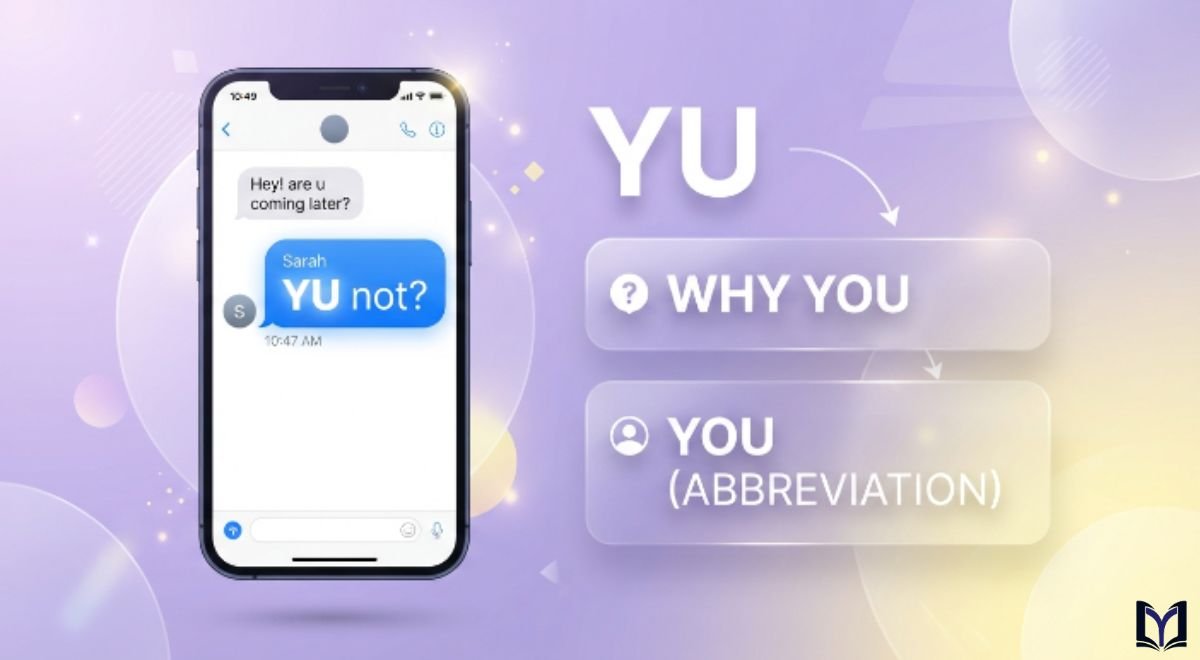
If you’ve ever received a message saying “yu?” you may have wondered, what does yu mean and whether it’s a typo or modern slang. In most casual conversations, “yu” simply means “you” and works as a quick spelling shortcut. You’ll often see this yu meaning in text on social media, messaging apps, and casual chats. However, the exact yu slang meaning can depend on the sentence, tone, and context.
Sometimes, readers may understand it as part of a “why you” question. This simple guide explains the meaning of yu, where people use it, how it sounds, and when it makes sense to use this popular texting shortcut in everyday conversations.
What Does YU Mean in Text?
The most common answer to what does yu mean in text is “you.” People use “yu” as a casual spelling of the word “you” in messages, comments, and online conversations. It isn’t usually a formal acronym. Instead, it works as a simple abbreviation, shortcut, or yu texting abbreviation that saves a few characters while keeping the meaning easy to understand. For example, someone might write “what are yu doing?” instead of “what are you doing?” The basic yu text meaning stays the same even though the spelling changes.
However, yu meaning in chat can change slightly depending on the context, sentence, and tone. In some messages, “yu” may appear in a phrase that readers interpret as “why you.” For example, “yu leaving already?” could be understood as “why are you leaving already?” This doesn’t mean “yu” always means “why you.” The most common yu meaning “you” remains the standard interpretation. You should look at the complete message before deciding what the person means.
| Text | Likely Meaning | Tone |
| “what are yu doing?” | What are you doing? | Casual |
| “miss yu” | Miss you | Affectionate |
| “yu there?” | Are you there? | Casual |
| “yu serious?” | Are you serious? | Surprised |
| “why yu leaving?” | Why are you leaving? | Questioning |
What Does YU Stand for in Texting and Slang?
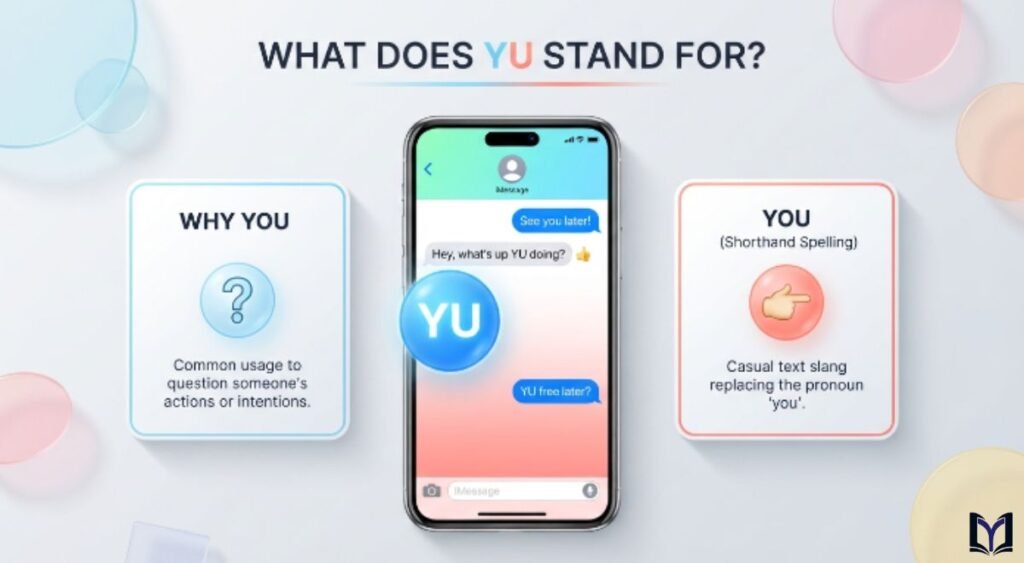
Unlike terms such as LOL or BRB, “yu” doesn’t normally stand for a longer phrase. Its yu slang meaning usually comes from shortening the spelling of “you.” This makes yu abbreviation different from many traditional internet abbreviations. It isn’t necessary to expand every letter because “yu” sounds close to “you” when spoken aloud. As a result, the reader can usually understand it quickly.
The use of “yu” fits into a much larger world of internet slang, texting shortcuts, and informal digital language. People often remove letters from familiar words when they know the reader can still understand the message. This habit appears in casual texting, comments, DMs, and other forms of informal communication. The goal isn’t usually to create a new meaning. Instead, it creates a faster and more relaxed way to communicate.
Is YU an Acronym or a Texting Shortcut?
“YU” usually works as a shortcut rather than a traditional acronym. It replaces the standard spelling “you” while keeping the same basic meaning. Think of it as a quick digital spelling choice rather than a phrase with separate words behind each letter.
Related Articles: What Does HY Mean in Text? Meaning, Uses, Examples & How to Reply
Where Is YU Commonly Used?
You can find yu in texting when people communicate casually with friends, family members, gaming partners, or social followers. It may appear in a text message, group chat, comment, or direct message. The term can also appear on Snapchat, WhatsApp, Messenger, TikTok, and Discord. Its use depends more on the person’s writing style than on one particular platform. Someone who likes short messages may use “yu” almost anywhere in an informal conversation.
The yu meaning on Snapchat, yu meaning on WhatsApp, and yu meaning on TikTok generally remains “you.” The platform may influence how informal the message feels, but it doesn’t automatically create a different definition. On social media, people often use shortened words because conversations move quickly. The same applies to gaming chat, where fast typing can matter when players need to respond immediately. Still, “yu” remains much less suitable for formal writing or serious professional messages.
| Platform or Setting | How YU May Appear | Typical Style |
| Snapchat | “miss yu” | Casual |
| “yu free tonight?” | Friendly | |
| Messenger | “what are yu doing?” | Casual |
| TikTok | “yu funny 😂” | Playful |
| Discord | “yu joining?” | Quick |
| Gaming chat | “yu ready?” | Fast-paced |
| Regular text | “yu there?” | Informal |
How Is YU Used in a Text Conversation?
The easiest way to understand how to use yu is to look at the complete conversation. Someone may use it in a question, statement, reaction, greeting, or emotional message. For example, “yu coming?” simply means “are you coming?” Likewise, “miss yu” means “miss you.” The shortened spelling doesn’t normally change the main message. It simply makes the casual chat feel quicker and less formal.
The surrounding words can also influence the tone. A message such as “yu okay?” may show concern, while “yu serious??” may express surprise or disbelief. Adding an emoji can make the intention even clearer. A heart may create a flirty tone or affectionate feeling, while a shocked emoji can strengthen a surprised reaction. Therefore, understanding yu in chat requires more than looking at two letters. You need to consider the complete sentence, relationship, and situation.
Common Ways People Use YU in Chat
People may write “yu” when asking questions such as “yu coming?” or “yu there?” They may also use it in friendly messages such as “miss yu” or “good talking to yu.” In a more emotional conversation, someone might write “yu okay?” to show concern.
Examples of YU in Text Messages

Real examples make the meaning of yu much easier to understand. Imagine two friends planning to meet. One person writes, “yu coming at 8?” The other understands the message immediately because the context makes the meaning obvious. In another conversation, someone might say, “i miss yu.” Here, “yu” clearly replaces “you” and gives the message a more relaxed style. These examples show how naturally the word can fit into casual conversations.
You may also see “yu” in playful, surprised, romantic, or emotional messages. For instance, “yu serious?” can express disbelief, while “yu okay?” can show concern. In a gaming chat, “yu joining?” simply asks whether another player will participate. The spelling stays the same, but the tone changes with the situation. That flexibility explains why the shortcut appears in many types of digital communication.
| Example | Standard English | Likely Tone |
| “what are yu doing?” | What are you doing? | Casual |
| “yu there?” | Are you there? | Neutral |
| “miss yu ❤️” | Miss you | Affectionate |
| “yu serious?” | Are you serious? | Surprised |
| “yu okay?” | Are you okay? | Caring |
| “yu coming tonight?” | Are you coming tonight? | Friendly |
| “yu joining the game?” | Are you joining the game? | Gaming |
| “good seeing yu” | Good seeing you | Friendly |
When Should You Use YU and When Should You Avoid It?
The best time to use “yu” is during relaxed informal communication with people who understand your texting style. Friends, gaming partners, social media followers, and close contacts are usually more comfortable with online slang. If someone already uses shortcuts such as “u,” “ur,” “wyd,” “wyb,” “hmu,” or “yh,” they will probably understand “yu” without difficulty. Matching the other person’s style can also make your conversation feel more natural.
However, you should choose standard “you” when clarity and professionalism matter. A job application, business email, school assignment, customer-service request, or formal announcement isn’t the right place for casual spelling. Professional communication should remain clear and polished. Using “yu” in those situations could make the message look careless. When you’re unsure, “you” is the safer choice because everyone understands it.
| Situation | “YU” Suitable? | Better Choice |
| Close friends | Yes | “yu” or “you” |
| Social media DM | Usually | “yu” |
| Gaming chat | Usually | “yu” |
| Group chat | Usually | “yu” |
| School assignment | No | “you” |
| Job application | No | “you” |
| Business email | No | “you” |
| Formal letter | No | “you” |
Is YU Friendly, Flirty, or Rude?
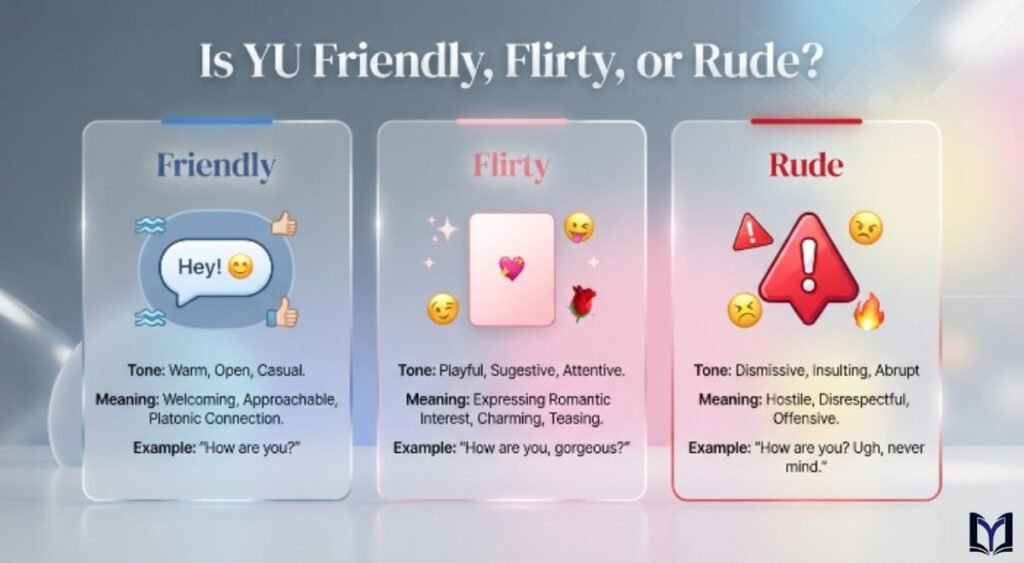
On its own, “yu” isn’t automatically friendly, romantic, or rude. Its meaning depends on the tone, relationship, punctuation, and words surrounding it. A friend saying “yu coming?” sounds normal and casual. Someone saying “miss yu ❤️” may sound affectionate or even romantic. Meanwhile, “yu serious??” can sound annoyed if the conversation already contains tension. The same two letters can therefore appear in very different emotional situations.
When you’re trying to understand a message, pay attention to the full context instead of judging the abbreviation alone. Emojis, punctuation, previous messages, and the relationship between two people can reveal the intended emotional tone. For example, “yu okay? ❤️” sounds caring, while “yu serious 🙄” may sound irritated. The abbreviation itself doesn’t create the feeling. The surrounding language does.
Related Articles: What Does HY Mean in Text? Meaning, Uses, Examples & How to Reply
Can YU Sound Flirty or Romantic?
Yes, “yu” can appear in a flirty tone when someone uses it inside an affectionate message. “Miss yu” or “can’t wait to see yu” may sound romantic when two people already have that type of relationship.
What Are the Other Meanings of YU?
Although yu meaning in text usually refers to “you,” context can sometimes produce another interpretation. One possible reading is “why you” when the phrase asks why someone is doing something. For example, “yu leaving already?” may be understood as “why are you leaving already?” In this case, the complete phrase carries the questioning meaning. It would be inaccurate to assume that every use of “yu” means “why you.”
Outside casual texting, “YU” can also appear as initials, usernames, names, organization abbreviations, or other specialized terms. Those meanings don’t automatically apply to a text message. If you’re reading a casual conversation and someone writes “miss yu,” the intended meaning is almost certainly “miss you.” The safest approach is to examine the words around “YU” and identify the topic of the conversation before choosing a definition.
| Context | Possible Meaning | Example |
| Casual texting | “you” | “miss yu” |
| Questioning phrase | “why you” | “yu leaving?” |
| Username | Personal identifier | “@yu123” |
| Initials | Person or organization | “YU” |
| Specialized context | Context-specific term | Depends on topic |
What Are Some Alternatives to YU in Texting?
If you want a more recognizable texting shortcut, “U” is probably the closest alternative. It directly represents “you” and has appeared in informal digital communication for many years. You may also see related shortcuts such as “ur” for “your” or “you’re,” although its exact meaning depends on context. Other terms such as “wyd,” “wyb,” “hmu,” and “yh” serve different purposes, so they aren’t direct replacements for “yu.”
The best alternative depends on how clear you want your message to be. “You” works everywhere and leaves almost no room for confusion. “U” feels more abbreviated, while “yu” can feel more playful or personal. If you’re writing to someone who doesn’t use much slang, standard “you” may be easier. In everyday casual texting, however, all three styles can work when both people understand the intended meaning.
| Shortcut | Meaning | Common Use |
| “u” | You | Very casual |
| “ur” | Your / You’re | Casual |
| “wyd” | What are you doing? | Asking about activity |
| “wyb” | Where you been? | Checking in |
| “hmu” | Hit me up | Asking someone to contact you |
| “yh” | Yeah | Casual agreement |
| “you” | You | All settings |
YU vs. U: What’s the Difference?
Both “yu” and “u” can represent “you,” but “u” has wider recognition as a traditional texting shortcut. “Yu” may feel more like a phonetic spelling, while “u” looks more abbreviated.
Why Do People Use YU Instead of “You”?
The simplest reason why people use yu is speed. Removing one letter makes the word slightly quicker to type, especially during rapid texting. For people who send many messages each day, these tiny shortcuts become natural habits. The difference may seem small, but digital conversations often contain dozens of short messages. A person may choose “yu” without thinking about it.
Style also matters. Some younger users use shortened spellings because they fit the relaxed nature of modern social media and messaging. A message written with “yu” can feel more casual than one written with perfect grammar. It may also match the writing style of friends or online communities. In this way, “yu” is less about saving a single keystroke and more about fitting into the rhythm of digital communication.
Does YU Make Texting Faster?
Yes, but only slightly. The bigger advantage comes from habit and style. Once a person becomes comfortable with texting shortcuts, writing “yu” can feel just as natural as typing the full word.
Conclusion
So, what does yu mean in text? In most cases, “yu” simply means “you.” It works as an informal spelling shortcut used in text messages, social media posts, DMs, and casual chats. The yu meaning in chat usually becomes obvious from the surrounding sentence. In some questioning phrases, readers may understand “yu” as part of “why you,” but that interpretation depends on context rather than being the default definition.
Overall, “yu” belongs to the world of casual slang, online slang, and quick digital communication. You can use it with friends, gaming partners, and social contacts when the setting feels relaxed. For schoolwork, business messages, applications, and other forms of formal writing, stick with “you.” Once you understand the context and tone, the yu meaning is usually simple to recognize.
FAQ’s About What Does Yu Mean
What does YU mean/stand for?
YU usually stands for or represents “you” in casual texting. It’s a shortened spelling rather than a formal acronym.
What is the meaning of YU?
YU generally means “you” in informal messages, chats, comments, and social media conversations.
What does “YU” mean when texting?
In texting, “YU” is a quick, casual way to write “you,” as in “what are yu doing?”
What does YU mean in slang?
In slang, YU usually means “you.” Its exact tone can change depending on the sentence and context.
Is Yu a female or male name?
Yu can be a name for either gender, depending on the culture and specific name. It can also appear as a surname.
Related Articles: What Does HY Mean in Text? Meaning, Uses, Examples & How to Reply

Welcome to Meanings There! I’m the creator and author behind this website, sharing useful meanings, explanations, and informative content to make words and phrases easier to understand.