


Ever seen someone comment “ratio” online and wondered what they were talking about? If you’re searching for what does ratio mean slang, the answer has little to do with math. In online conversations, “ratio” usually describes a situation where one reply gets much more engagement or support than the original post. You may also see phrases like “got ratioed” or “ratio this” during heated debates, funny exchanges, and viral posts.
The meaning can shift slightly between X, TikTok, Instagram, and private chats. This guide explains the ratio slang meaning, common examples, its origin, and how people use it in modern internet slang without confusion.
What Does Ratio Mean Slang?
The simplest ratio meaning slang definition is a public comparison of online reactions. When someone says “ratio,” they may suggest that a reply will receive more likes, reposts, or other forms of support than the original post. In another common use, the term describes a post that attracts far more critical replies than positive engagement. The exact comparison changes with the platform, but the central idea stays the same: people are comparing visible audience reactions.
That makes what does ratio mean a little more complicated than a one-line dictionary definition. Someone might write “ratio” before a response gets attention, almost like a challenge. Another person might say “you got ratioed” after the response has already outperformed the original. In both cases, internet slang turns audience behavior into a kind of public scoreboard. However, a strong reaction doesn’t automatically mean one side is factually correct. Engagement measures what people did online. It doesn’t prove that an opinion is true.
Ratio Slang Meaning in Simple Words
Think of ratio slang as a popularity comparison during an online exchange. Imagine a post receives 300 likes, while a clever reply underneath receives 8,000. People may call that a ratio because the response attracted much more positive reaction than the original statement.
The same idea can appear when a post receives hundreds of angry comments but very few likes. In that situation, users may say the post was ratioed because its visible public reaction appears heavily negative. There is no universal formula, though. Context matters more than a fixed number.
What Does Ratio Stand For?
If you’re searching for the ratio full form, there is an easy answer. “Ratio” doesn’t stand for a longer slang phrase. It isn’t an acronym like LOL or TBH. The what does ratio stand for question usually comes from people assuming every internet term has a hidden expansion.
Instead, the word comes from the ordinary idea of comparing quantities. Online users adapted that idea to compare social media engagement and public reactions. The ratio definition therefore has two useful sides: the traditional mathematical meaning and the newer internet meaning.
What Does “Ratio” Mean in Text and Chat?
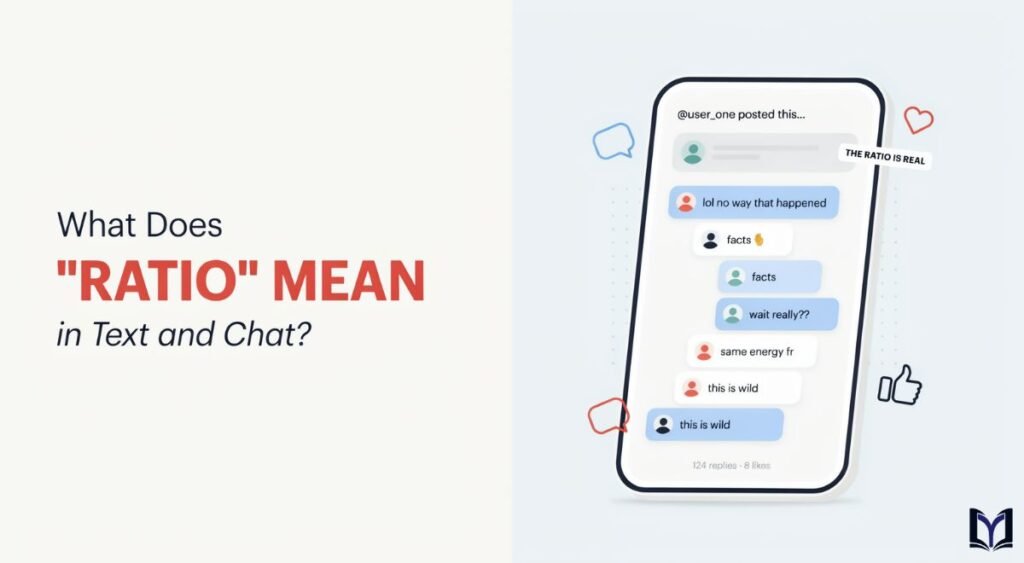
The ratio meaning in text depends heavily on the conversation. On a public platform, the word can point directly to visible engagement numbers. In a private chat, however, there may be no actual numbers to compare. Friends can still use the expression as casual slang to joke that one person delivered a better comeback or made the stronger point.
For example, imagine a friend says, “You drink coffee way too much.” You reply, “At least I don’t order five energy drinks before noon.” Your friend might answer, “Ratio.” Nothing has been measured. Instead, they’re using ratio in texting as a playful way to say that your comeback supposedly won the exchange. This is why ratio meaning in chat can be broader than its original social-media use.
What Does “Ratio” Mean in a Text Message?
When someone sends “ratio” in a text message, don’t automatically assume they’re talking about mathematics. Look at what happened immediately before it. If someone made a joke, comeback, or bold claim, “ratio” may simply mean that the sender thinks another person had the better response.
In other words, ratio meaning in a text message often works like a humorous scorecard. The sender may be teasing rather than making a serious claim about online engagement. Tone, emojis, friendship, and the surrounding conversation can completely change the meaning.
What Does It Mean to Get Ratioed?
Getting ratioed usually means that a person’s post receives an unfavorable engagement pattern. One common version occurs when replies greatly outnumber likes or reposts. Another common version happens when a response gets substantially more likes than the post or comment it challenges. Both meanings appear in current social-media usage.
The phrase got ratioed often carries a teasing or negative tone. For example, someone could post an unpopular opinion, receive 200 likes, and then watch a critical reply collect 10,000 likes. Other internet users might say, “You got ratioed.” Still, that doesn’t mean the crowd necessarily proved anything. A popular response can be funny, emotional, misleading, or simply easier to agree with.
Related Articles: IDM Meaning Text: What Does IDM Mean in Chat & Social Media
What Does “Got Ratioed” Mean?
“Got ratioed” means someone became the less-supported side of a visible online exchange. It can refer to the original poster or to a person whose comment was outperformed by another response.
For instance, if someone writes, “Nobody likes this band,” and another user responds with evidence that thousands of fans disagree, the second response might receive much more attention. If that happens, commenters could say the first person got ratioed. The phrase usually describes the social reaction, not an official action taken by the platform.
How Is Ratio Used on Social Media?
The ratio meaning social media has developed around visible reactions. On platforms where users can see likes, replies, comments, reposts, or shares, people can compare how audiences respond to different statements. A user might try to ratio a post, ratio a comment, or ratio an opinion by writing a response that they hope will attract more attention.
The expression also works as a prediction. Someone may simply comment “ratio” beneath a controversial statement. In that situation, they’re often challenging other users to support the response more strongly than the original. This makes “ratio” both a description and a call to action. Current explanations of the term note that it can function as a noun, verb, or challenge across online conversations.
How Does a Social Media Ratio Work?
Consider this simple example:
| Situation | Original Post | Reply | Possible Reading |
| Example 1 | 500 likes | 5,000 likes | The reply may be viewed as a ratio |
| Example 2 | 4,000 likes | 4,100 likes | The difference is less dramatic |
| Example 3 | 1,000 likes | 15,000 likes | A strong engagement comparison |
| Example 4 | 300 likes | 4,000 critical replies | The post may be described as ratioed |
These numbers are examples, not official thresholds. No universal rule says a reply must reach a specific number before it becomes a ratio. On X, users have traditionally looked at replies compared with likes or reposts. On TikTok and other platforms, they may compare the likes on one comment with another.
What Does Ratio Mean on X, TikTok, and Instagram?

The ratio meaning on X is closely tied to the term’s original social-media culture. A post may be considered ratioed when it receives many more replies than likes or reposts, suggesting that users are responding critically instead of simply approving it. Another common interpretation is that a reply or quote post receives more likes than the post it answers.
The ratio meaning on TikTok and the ratio meaning on Instagram can be more flexible. Users may compare the likes on a reply with the likes on the comment it challenges. People also use the word more casually in comment sections. Because each platform has different features, the exact meaning isn’t identical everywhere. The safest approach is to identify what two pieces of engagement the speaker is comparing.
What Does Ratio Mean on X?
On X/Twitter, “ratio” has a strong connection with public disagreement. A post with relatively few likes but a large number of replies may look like it has attracted criticism rather than approval. Users may also call a reply successful when it receives more likes than the original post.
The practice became widely associated with Twitter during the 2010s. A well-known 2017 example involved United Airlines, whose response to a passenger-related controversy received dramatically more replies than likes. The example helped illustrate why users began treating engagement patterns as a public signal of approval or disapproval.
What Does Ratio Mean on TikTok and Instagram?
On TikTok, “ratio” can describe a reply that receives more likes than the comment or content it challenges. It can also appear as a challenge for viewers to support a particular response. The broader concept remains the same: one visible response appears to outperform another.
On Instagram, users can also borrow the expression for comment exchanges. A response that receives much more attention than the original comment may be described as a ratio. The slang has spread beyond X because many modern platforms display public engagement in ways that make these comparisons easy to notice.
Is Ratio Slang Rude, Offensive, or Negative?
The word “ratio” isn’t inherently a swear word or offensive term. Its emotional effect comes from how someone uses it. A friend might say “ratio 😂” after a funny comeback. A stranger might use the same word during an online argument to mock someone. That difference shows why context and tone matter so much in social media slang.
The expression can also become more hostile when users use it to encourage a pile-on. A single joke is one thing. Repeatedly directing large groups toward a person is another. Online harassment can grow from seemingly harmless engagement games, especially when a large audience targets one individual. So, while the slang itself is generally harmless, the behavior surrounding it can become unpleasant.
Is Saying “Ratio” an Insult?
Sometimes it is. Saying “ratio” can imply that someone has lost the crowd or made an unpopular argument. That implication can feel embarrassing, particularly when hundreds or thousands of people join the exchange.
However, the expression isn’t always hostile. Friends often use it for teasing or playful competition. The same phrase can therefore range from harmless banter to open mocking, depending on the relationship and situation.
Is “Ratio” Safe to Use?
In ordinary online conversation, “ratio” is generally safe as informal language. It isn’t inherently obscene. Still, the setting matters.
| Situation | How “ratio” may sound |
| Friends joking | Playful |
| Meme conversation | Humorous |
| Online debate | Competitive |
| Argument with a stranger | Dismissive |
| Sensitive personal discussion | Potentially insensitive |
| Workplace email | Too informal |
| Academic assignment | Usually inappropriate |
In formal communication, clearer language usually works better. Instead of writing “ratio,” you can explain your actual point. That gives the other person something meaningful to respond to.
Ratio vs. Ratioed vs. “Ratio This” vs. “L + Ratio”
The difference between ratio vs ratioed is mostly about usage and timing. “Ratio” can describe the phenomenon or act as a challenge. “Ratioed” describes someone who has already experienced the result. “Ratio this” usually encourages other people to support a response. “L + ratio” combines the idea with another popular slang term for a loss.
These expressions often appear in fast-moving online communities where users understand the shorthand immediately. They can sound confusing to someone unfamiliar with internet terminology, but the pattern is fairly simple once each phrase is separated.
| Expression | Common meaning |
| Ratio | A public engagement comparison or challenge |
| Ratioed | Received a less favorable engagement result |
| Ratio this | Encourages others to make a response outperform the target |
| L | Indicates a loss or failure |
| L + ratio | Combines “loss” with a ratio-based put-down |
Ratio vs. L
L usually means loss in online slang. People may use it when someone loses an argument, makes a poor decision, or experiences an embarrassing moment. In that sense, W represents a win.
L + ratio adds another layer. It suggests that someone took a loss and also received an unfavorable public reaction. The phrase is often deliberately exaggerated, which makes it common in meme culture.
Ratio vs. Ratioed
“Ratio” can describe the action or outcome. “Ratioed” usually describes the person or post after the unfavorable comparison has happened.
For example, “Ratio this” is a challenge. “That reply ratioed him” describes an alleged win by the reply. “He got ratioed” describes the person who received the unfavorable result.
Ratio Slang Examples in Conversations
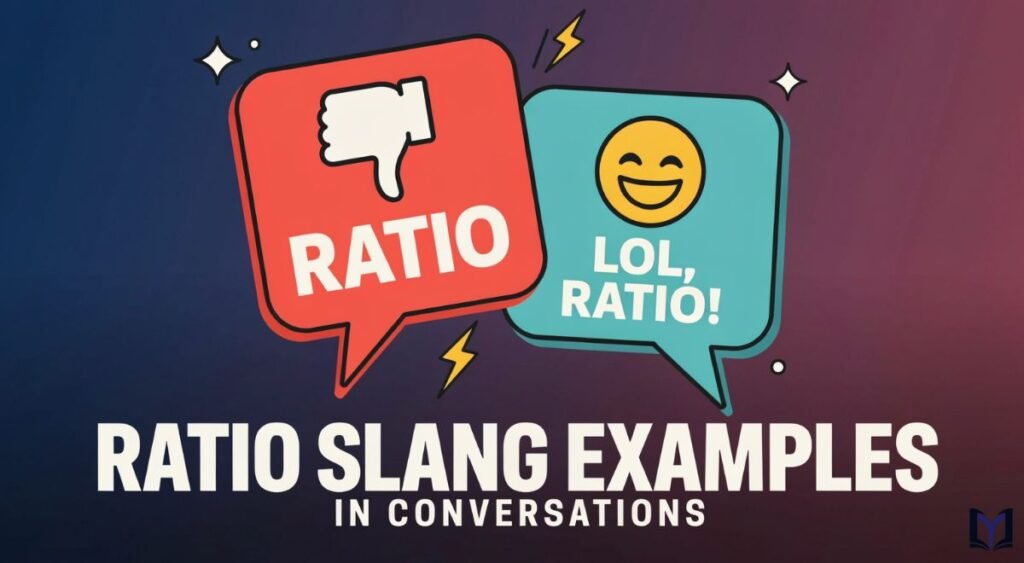
Real examples make ratio slang meaning much easier to understand. Imagine a user posts, “This is the worst pizza in town.” Another person replies, “You ordered pineapple and chocolate.” If that reply gets far more likes than the original, someone might comment, “Ratio.” The word suggests that the second response has stronger public support.
The expression can also appear in gaming communities, meme communities, sports discussions, entertainment debates, and everyday social-media conversations. Its purpose remains similar, but the tone changes. Sometimes it celebrates a clever comeback. Sometimes it mocks an unpopular opinion. Sometimes it simply points out an obvious difference in engagement.
Friendly Ratio Example
Alex: “I make the best homemade pizza.”
Sam: “You literally put chocolate on it.”
Alex: “That was experimental!”
Jordan: “Ratio 😂”
Here, “ratio” is playful. Jordan isn’t seriously attacking Alex. The slang expression simply treats Sam’s comeback as the better response.
Social Media Ratio Example
Original post: “Nobody listens to this band anymore.”
Reply: “Their latest tour sold out in minutes.”
If the reply receives thousands of likes while the original receives very little support, another user might write:
“Ratio.”
The commenter is suggesting that the response has attracted stronger positive engagement and public agreement.
Argumentative Ratio Example
Post: “This rule makes no sense.”
Reply: “Here is the official data explaining why it exists.”
If the reply receives far more attention, people might say the original post was ratioed. The term signals that the response appears more popular, but it doesn’t independently prove that the response is correct.
Where Did Ratio Slang Come From?
The ratio vs traditional ratio connection is easier to understand when you look at the basic idea of comparison. A traditional ratio compares quantities. Social-media users borrowed that concept and applied it to online engagement. Instead of comparing apples with oranges, users began comparing likes, replies, reposts, and other visible reactions.
The modern slang became strongly associated with Twitter during the 2010s. Sources discussing the term commonly point to 2017 as an important period in its development. The practice later spread to TikTok, Instagram, and other platforms. However, there isn’t a single universally accepted person who can be credited with inventing the entire slang usage.
When Did “Ratio” Become Internet Slang?
The slang use became especially visible around 2017, when Twitter users began comparing replies, likes, and reposts to judge how a post had been received. Contemporary explanations and later references identify that period as a key stage in the term’s development.
Over time, the meaning expanded. Users didn’t just describe a bad engagement pattern. They started saying “ratio” as a challenge. Then ratioed became a common description for someone who appeared to lose the engagement battle. Later, the phrase L + ratio became part of broader meme and gaming-style internet culture.
Ratio Slang vs. Traditional Ratio: What’s the Difference?
A mathematical ratio compares two quantities or amounts. For example, a 2:1 ratio means one quantity is twice another. This is the original, everyday meaning of the word. Dictionaries still define ratio primarily as a relationship between quantities, while also recognizing its social-media usage.
The online version borrows the same comparison idea but changes what gets measured. Instead of comparing numbers of objects, users compare engagement numbers, audience reactions, or the popularity of one response against another. The concept is similar. The context is completely different.
| Term | Meaning | Example |
| Traditional ratio | Comparison between quantities | 2:1 |
| Social media ratio | Comparison of online reactions | A reply gets far more likes |
| Ratioed | Received an unfavorable engagement comparison | “That post got ratioed.” |
| Ratio someone | Outperform someone’s post or comment | “She ratioed him.” |
| Ratio this | Challenge others to support a response | “Ratio this.” |
Why Does the Slang Use the Word “Ratio”?
The word works because online engagement creates visible numbers. Users can compare one post with another almost instantly. That makes the mathematical idea of comparison a useful metaphor for social approval.
In simple terms, the traditional ratio asks, “How much does one quantity compare with another?” The slang version asks something closer to, “How much more support did this response get?”
Related Articles: IDM Meaning Text: What Does IDM Mean in Chat & Social Media
Why Do People Say “Ratio” Online?
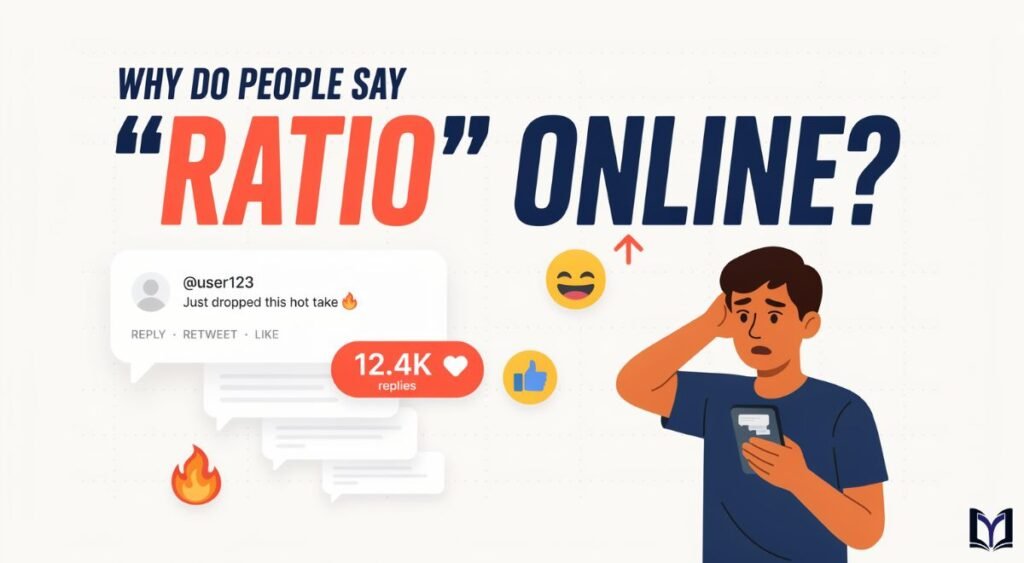
People say ratio because it is short, recognizable, and packed with meaning. A single word can signal disagreement, humor, competition, approval of a reply, or mockery of an original post. On fast-moving platforms, that efficiency matters. Nobody needs to write a paragraph when one familiar internet phrase can communicate the idea.
The expression also fits modern internet culture. Social media turns reactions into visible numbers. Likes and reposts, comments, shares, and replies can make audience behavior feel measurable. That creates a natural environment for slang based on comparison. Still, engagement isn’t a perfect measure of truth, quality, or expertise. A viral response can be entertaining without being accurate.
Why Is “Ratio” So Popular in Internet Slang?
The biggest reason is simplicity. Typing “ratio” takes seconds. Explaining that a reply has stronger audience approval takes much longer.
There is also a competitive element. Social platforms often reward quick reactions, clever comebacks, and memorable phrases. “Ratio” fits that environment perfectly. It turns a complicated social media debate into a tiny verbal scoreboard.
Common Mistakes When Using Ratio Slang
One common mistake is assuming ratio always means an insult. It doesn’t. Friends may use it for jokes. Another mistake is believing the term has a ratio full form. It doesn’t. The word isn’t an acronym. It simply gained a newer slang meaning through online culture.
Another misunderstanding involves engagement numbers. More likes don’t automatically prove that someone won an argument. A funny comment can receive thousands of likes because it is entertaining. A factual correction might receive fewer because fewer people see it. The numbers show audience behavior, not objective truth.
Does More Engagement Always Mean Someone Is Right?
No. Social media engagement isn’t the same as evidence. A popular post can contain an incorrect claim. A smaller response can contain accurate information.
For example, imagine an inaccurate celebrity rumor receives 50,000 likes because it is shocking. A careful correction receives only 2,000 likes. The rumor has more online popularity, but that doesn’t make it true. This is why a ratio should be understood as a social signal rather than a final verdict.
How to Respond When Someone Says “Ratio”
When someone says “ratio,” you don’t have to respond at all. If the exchange is clearly playful, you can joke back. If the conversation is becoming hostile, stepping away may be more useful than competing for engagement. A one-word response can easily turn a small disagreement into a much larger online argument.
If you want to respond seriously, address the actual claim instead of the engagement numbers. For example, you can explain why you disagree or provide evidence. That approach keeps the conversation focused on substance rather than turning it into a popularity contest.
Polite Alternatives to “Ratio”
If you want to disagree without sounding mocking, you can say, “I think the second point is stronger.” You could also write, “I see this differently,” or “That response makes more sense to me.” These phrases communicate your position without encouraging a pile-on.
For a more direct response, try, “The evidence supports the reply,” or “A lot of people seem to disagree with the original claim.” These alternatives work especially well when the discussion involves a serious topic. They also make your reasoning clearer than simply writing “ratio.”
Conclusion
So, what does ratio mean slang? In most online conversations, it refers to a visible comparison between the reaction to an original post and the reaction to a response. A person may use “ratio” as a challenge, describe a successful ratio reply, or say someone got ratioed after an unfavorable engagement pattern. The exact meaning can vary between X, TikTok, Instagram, and private chats.
The key is to remember that ratio meaning slang isn’t the same as a mathematical ratio. Online, the word has become part of internet slang, social media slang, and everyday digital communication. It can be funny, competitive, teasing, or negative. Most importantly, engagement only shows how people reacted. It doesn’t automatically prove who was right.
FAQ’s About What Does Ratio Mean Slang
What does ratio mean slang?
In slang, “ratio” means a reply or comment gets more engagement or support than the original post, often signaling disagreement.
What does the ratio on Twitter mean?
On Twitter/X, a “ratio” usually means a reply gets significantly more likes or engagement than the original post, often because people disagree with it.
What does “ratio” mean in TikTok slang?
On TikTok, “ratio” is used to predict or point out that a comment or response will receive more likes or support than another comment or post.
What does L ratio mean on TikTok?
“L ratio” combines “L” (loss) with “ratio” to mock someone when their opinion or post receives a weaker public reaction.
What does “ratio” mean on Urban Dictionary?
On Urban Dictionary, “ratio” generally refers to getting more favorable engagement on a reply or comment than the original post, often during an online argument.
Related Articles: IDM Meaning Text: What Does IDM Mean in Chat & Social Media

Welcome to Meanings There! I’m the creator and author behind this website, sharing useful meanings, explanations, and informative content to make words and phrases easier to understand.
1 thought on “What Does Ratio Mean Slang? Meaning, Definition & Examples”