

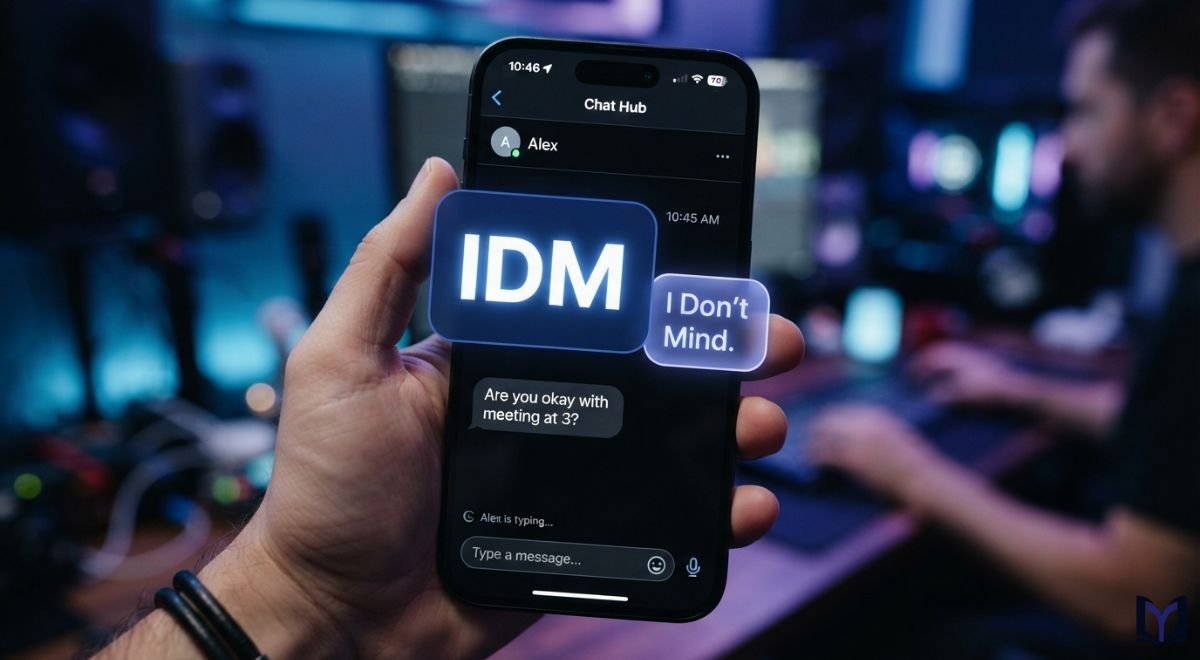
Ever received a message saying “IDM” and wondered what the person meant? You’re not alone. In texting, IDM is a shortcut that can make conversations quicker and easier. Most often, it means “I Don’t Mind,” showing that you have no preference and feel flexibility about a choice or suggestion. You may see this abbreviation in chats, group conversations, Snapchat, and Instagram messages.
However, IDM can carry different meanings in other settings, so context matters. Understanding IDM meaning in text helps you reply naturally and avoid misunderstandings. In this guide, you’ll learn what IDM means, how people use it, when to send it, and how to respond correctly in everyday conversations.
What Does IDM Mean in Text?
The most common answer to what does IDM mean is “I Don’t Mind.” In text messages, people use it to say they feel okay with a suggestion, choice, or decision. It often means they have no preference and will accept whatever works. For example, if someone asks, “Do you want to meet at 6 or 7?” you can reply, “IDM, 7 works.” Here, the phrase communicates agreement and acceptance in a relaxed way. The I Don’t Mind meaning feels neutral, friendly, and easygoing. It usually does not show excitement. It simply tells the other person that either option works.
Another possible interpretation sometimes appears in casual conversations: “It Doesn’t Matter.” The It Doesn’t Matter meaning can overlap with “I Don’t Mind,” especially when someone has no strong preference. However, the tone can differ slightly. “I don’t mind” often sounds more cooperative, while “it doesn’t matter” can sound more detached depending on the message. In ordinary IDM in texting, the phrase still usually points toward flexibility. That makes it useful during planning, quick questions, and casual choices. When you understand the surrounding conversation, the meaning becomes much easier to recognize.
IDM Meaning: “I Don’t Mind”
At its core, “I Don’t Mind” tells another person that you are comfortable with an option. You are not objecting. You may even be happy to let them decide. The phrase works especially well during casual conversation, where speed matters. Instead of typing “I don’t have a preference,” you can type “IDM.” It works like a small verbal shrug. You are basically saying, “Either choice is fine with me.”
What Does IDM Stand for in Texting?
When people ask what does IDM stand for, the answer depends on the setting. In casual online communication, it most often means “I Don’t Mind.” The same abbreviation may mean something else in technology, music, or business. That distinction matters. A friend saying “IDM, you choose” almost certainly uses the common slang meaning. A software discussion about download speeds could point to something entirely different.
Why IDM Has Become Common in Digital Chats
Modern texting culture rewards short expressions. People often want to save time and save typing effort while still making their message clear. That habit has helped many texting abbreviations become part of everyday speech. IDM fits naturally into that pattern. It is short, recognizable, and useful during fast-moving chats.
What Does IDM Mean on Snapchat and Social Media?
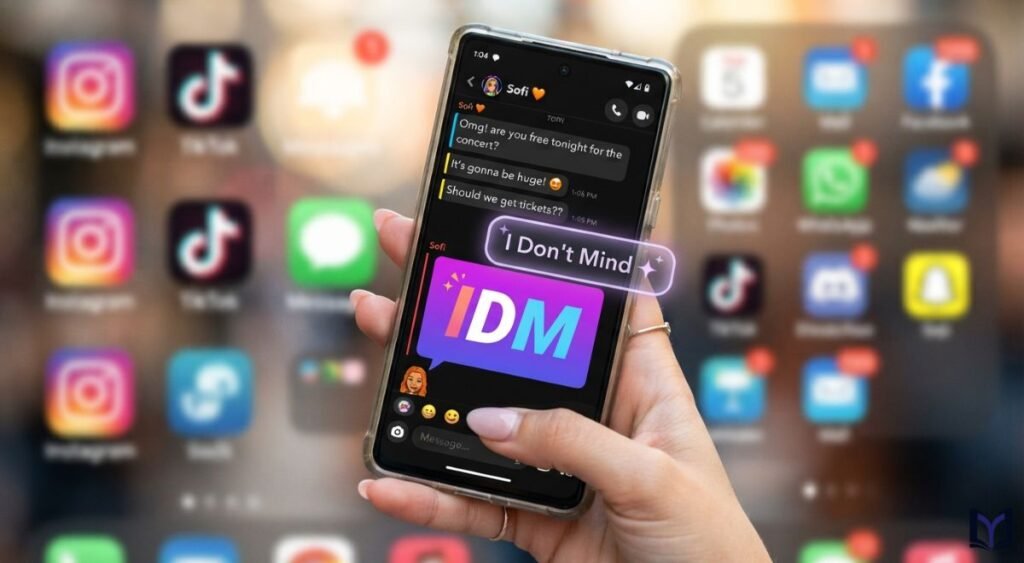
The IDM meaning on Snapchat usually remains “I Don’t Mind.” Snapchat conversations move quickly, so users often favor compact slang and short phrases. You might send “IDM” when a friend asks which filter to use, where to go, or what time to meet. The phrase gives the other person room to decide. On Snapchat, that relaxed tone often matches the platform’s casual style. The same idea applies to IDM on social media, especially when people respond to comments, direct messages, or quick questions.
The IDM meaning on Instagram also usually points to “I Don’t Mind” when the discussion involves casual choices. Someone might ask, “Want the black version or the white one?” A reply such as “IDM” means either works. You may also spot the term on Twitter, TikTok, or other platforms where users rely on social media slang. Still, you should never assume an acronym has one universal definition. Look at the words around it. The subject, tone, and platform can all provide clues.
Related Articles: ION Mean in Text? Meaning, Slang, Contexts, Example & Usage
IDM Meaning on Snapchat
When someone writes “IDM” on Snapchat, they normally express flexibility. A friend might ask, “Do you mind if I bring Sarah?” You could answer, “IDM.” That response means you are fine with the idea. It keeps the conversation moving without making the exchange feel formal or heavy.
IDM on Instagram, TikTok, and Other Platforms
Across Instagram, TikTok, and Twitter, IDM often works the same way. Users rely on short forms to keep messages compact. The meaning usually depends on the discussion rather than the platform itself. If the conversation involves a choice or suggestion, “I Don’t Mind” is often the most sensible reading.
How Context Changes IDM’s Meaning Online
Online language can be slippery. The same three letters may mean different things in different communities. A conversation about music could use IDM to refer to Intelligent Dance Music. A software post could mention Internet Download Manager. Always check the context before deciding what an acronym means.
How Is IDM Used in Texting and Everyday Conversations?

The easiest way to understand how to use IDM is to picture moments when someone asks for your preference. You may not care about the answer. Perhaps a friend asks which restaurant to choose. Maybe a coworker asks whether Tuesday or Wednesday works better for a casual meeting. In those cases, “IDM” shows acceptance without adding unnecessary detail. It is especially natural in casual texting and IDM in chat. The phrase can sound warm when the rest of the message feels friendly. For example, “IDM, you pick 😊” sounds more inviting than a bare “IDM.”
In everyday IDM in conversations, the word can also signal that you are easygoing. However, your tone still matters. A one-word “IDM” can feel flat if the conversation involves emotions or an important decision. Adding a few words often makes your meaning clearer. “IDM, whatever works for you” sounds relaxed. “IDM, I’m good either way” sounds even more natural. The goal is not only to shorten your message. It is to communicate the right attitude.
Using IDM to Show Flexibility
IDM often acts as a shortcut for “I’m flexible.” You can use it when several choices seem equally acceptable. This makes the abbreviation useful during planning. It tells the other person that they do not need to worry about pleasing you with a specific option.
Using IDM to Accept a Suggestion
When someone suggests an idea and you have no objection, IDM can signal agreement. For example, “Want to watch a comedy?” followed by “IDM” tells the other person that you are open to it. The exact level of enthusiasm depends on the rest of the chat.
Using IDM When You Have No Preference
“No preference” sits at the heart of many IDM messages. You use it when the final choice does not matter much to you. In that sense, IDM gives someone else the steering wheel. It is a simple way to say, “Up to you.”
What the Tone of IDM Usually Suggests
The typical tone is neutral tone with a hint of friendly tone. However, context can change the feeling. A thoughtful message can make IDM sound cooperative. A dry one-word response may sound distant. Tone comes from the whole message, not from the acronym alone.
Different Contexts Where IDM Can Be Used
You can use IDM in many casual situations. Friends often send it while choosing restaurants, movies, travel times, or weekend plans. In group chats, one person may ask everyone to vote on a time. Saying “IDM” means you are happy with whichever option wins. The same idea can appear in dating and relationships, where people often negotiate small choices such as where to eat or what to watch. IDM can make those conversations feel lighter. It shows that you do not need to control every decision.
Still, the phrase works best when the issue truly does not matter to you. Imagine a friend asks about something important to your plans. Saying “IDM” could create confusion if you actually have a preference. In those moments, clarity beats brevity. A fuller sentence may prevent misunderstandings. That balance matters in digital communication. Good texting is not about using the shortest possible message. It is about using the shortest message that still communicates your intent.
IDM in Conversations With Friends
Friends use IDM frequently because friendship allows more relaxed language. “Dinner at 7?” followed by “IDM” feels natural. You can even add an emoji to make the message warmer. The informal setting makes the abbreviation easy to understand.
IDM in Group Chats
Group chats provide another natural setting. When a group debates several choices, IDM tells everyone you are flexible. It can help prevent a simple discussion from turning into a long back-and-forth exchange.
IDM in Dating and Relationships
In dating and relationships, IDM can show that you are willing to compromise. Someone may ask, “Coffee or dinner?” A reply such as “IDM, what sounds good to you?” keeps the mood relaxed. Yet emotional issues require more direct language.
IDM When Making Plans or Decisions
Planning often creates endless tiny decisions. IDM can cut through those small details. If you genuinely do not care whether the movie starts at 6:30 or 7:00, saying “IDM” saves time and keeps things moving.
IDM in Comments and Social Media Messages
On social platforms, IDM may appear in a reply to a suggestion. Someone could ask, “Blue or green?” You might answer, “IDM.” This kind of quick response fits the fast pace of online interaction.
How to Tell Which Meaning of IDM Is Intended
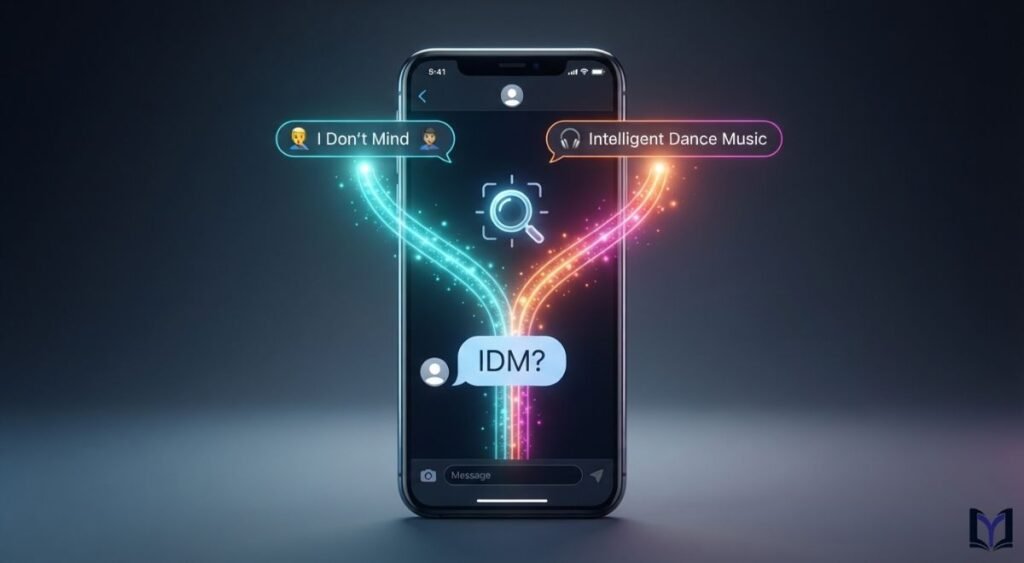
Understanding what does IDM mean in a text message starts with context. Look at the topic first. Is someone asking about a choice? Are they responding to a suggestion? Does the discussion feel casual? If so, “I Don’t Mind” is the strongest interpretation. The clues often sit right beside the acronym. A message such as “Pizza or burgers? IDM” clearly suggests that the sender does not have a preference.
Other situations require more caution. Suppose you see “IDM” in a software forum. The discussion might involve Internet Download Manager. In a music conversation, it could mean Intelligent Dance Music. In a corporate setting, someone may discuss Identity Management. That is why guessing from the letters alone can lead you astray. Acronyms are like road signs. You need the surrounding landscape to know which direction they point.
Context Clues That Reveal the Meaning
The topic offers the strongest clue. Food, plans, friends, and casual choices usually support the slang meaning. Software, cybersecurity, music, or business discussions can signal something else. The surrounding words provide the missing pieces.
IDM vs “I Don’t Care”
The difference between IDM vs IDC can be subtle. “I Don’t Mind” often sounds more cooperative. “I Don’t Care” can sound more dismissive. Compare “IDM, you choose” with “IDC, you choose.” The first feels flexible. The second may feel indifferent.
When IDM Could Mean Something Else
The phrase can refer to several alternative meanings of IDM outside casual texting. These meanings include Internet Download Manager, Intelligent Dance Music, and Identity Management. The correct definition depends on the subject and audience.
How to Use IDM Correctly in a Text
To use IDM naturally, choose moments when you genuinely do not have a preference. You can send “IDM” after a question, suggestion, or proposed plan. For example, “Do you want to sit inside or outside?” “IDM, whatever you prefer.” That exchange feels normal because the abbreviation directly answers the question. When you learn how do you use IDM in a text, the main rule is simple: use it when either choice works for you.
You should also consider who receives your message. With friends, classmates, or people you know well, the abbreviation usually fits. In professional communication, a clearer phrase often works better. A manager may understand IDM immediately. Even so, “I don’t have a preference” sounds more polished in a formal message. Good communication depends on audience, purpose, and tone. An abbreviation can be correct while still being the wrong choice for the situation.
When You Should Send IDM
Use IDM when you are comfortable with another person choosing. It works well for food, movies, meeting times, casual plans, and simple suggestions. The more relaxed the conversation, the more natural IDM tends to feel.
When You Should Avoid Using IDM
Avoid IDM when someone needs a definite answer from you. It can also cause problems during serious conversations. If your choice affects money, work, deadlines, or relationships, explain your position clearly instead of hiding behind an acronym.
Examples of Natural IDM Usage
Natural examples include “IDM, you choose,” “IDM either way,” and “IDM, whatever works.” These messages clearly express no preference. They also sound more human than a bare acronym in some situations.
Common Mistakes to Avoid With IDM
One common mistake involves using IDM when you actually do care. Another involves using it in formal settings where informal language may sound too casual. Some people also confuse IDM with IDC. A small difference in wording can create a big difference in tone.
How to Reply When Someone Says “IDM”
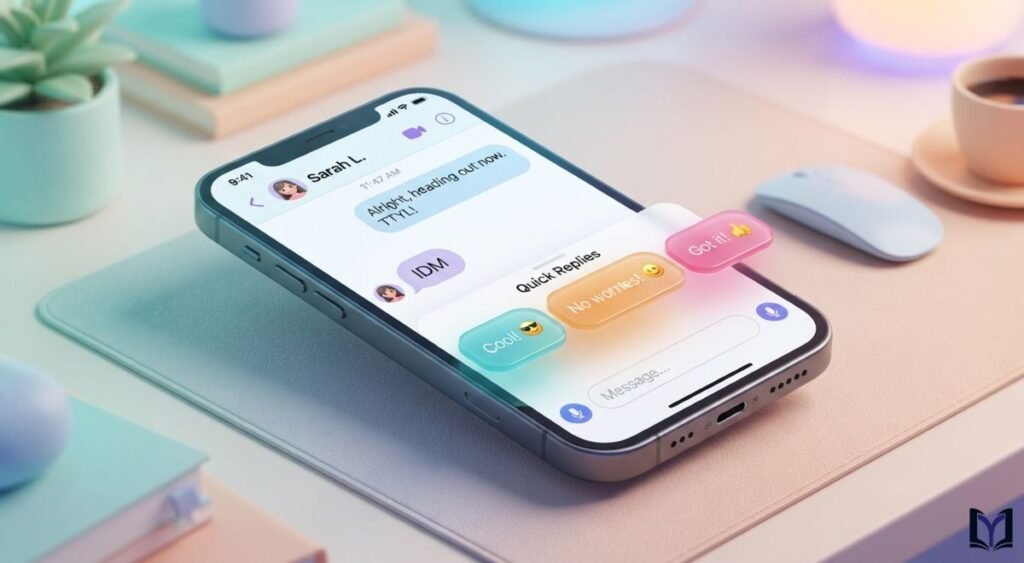
Learning how to reply to IDM becomes easy once you understand the intended tone. If the person means “I Don’t Mind,” you can simply move ahead with your preferred option. For example, if someone says “IDM” after you ask about dinner, you could reply, “Cool, let’s do tacos.” You can also answer with “Either works”, “Up to you”, or “No problem.” When someone uses IDM to accept a favor or suggestion, a simple “Thanks” may fit better.
You do not always need a response. Sometimes IDM naturally closes the exchange. Imagine you ask, “Can we meet at 7 instead?” and the other person replies, “IDM.” The conversation may already feel complete. In a fast-moving chat, another message may add nothing. However, if the topic matters, continuing the conversation can prevent confusion. A simple follow-up often makes the situation crystal clear.
What to Say When They Mean “I Don’t Mind”
You can respond with the option you prefer. “Great, let’s go at 7” works well. You could also say, “Perfect, I’ll choose.” The best response depends on what decision still needs to happen.
Friendly and Casual Replies to IDM
Casual replies can include “Either works,” “Up to you,” “No preference,” or “I’m flexible.” These alternatives preserve the same relaxed tone. Emojis can also soften the exchange when appropriate.
When You Don’t Need to Reply
A reply may be unnecessary when IDM finishes the decision. If the message clearly gives you permission to choose, you can simply make the choice. Not every short text requires another short text.
IDM Examples in Real Text Conversations
Real conversations make the IDM examples much easier to understand. Picture two friends deciding where to eat. One asks, “Chinese or Mexican?” The other replies, “IDM, you pick.” The second person does not reject either option. Instead, they show flexibility and pass the decision back. Now imagine another chat where a friend asks, “Is 8 okay?” A response such as “IDM, 8 works” confirms the plan without turning it into a long discussion.
The same pattern appears in social chats, family messages, and group planning. However, the tone can shift based on the wording around IDM. “IDM 😂” may feel playful. “IDM.” may feel blunt. “IDM, whatever works for you” sounds warmer and more cooperative. These tiny differences matter because text removes facial expressions and voice cues. Readers often rely on wording, punctuation, and emojis to interpret intent.
IDM Examples Between Friends
A: “Movie at my place or yours?”
B: “IDM, yours is closer.”
A: “Wanna grab coffee tomorrow?”
B: “IDM. What time works?”
A: “Pizza or burgers tonight?”
B: “IDM, you choose.”
These examples show how IDM in conversations can communicate openness without sounding complicated.
IDM Examples for Making Plans
A: “Should we meet at 6 or 6:30?”
B: “IDM, either works.”
A: “Want to drive or take the train?”
B: “IDM, whatever’s easier.”
A: “Friday or Saturday?”
B: “IDM, I’m free both days.”
The common thread is clear. The sender does not have a strong choice or preference.
IDM Examples on Snapchat and Social Media
Snap: “Blue outfit or black?”
Reply: “IDM 😄”
Instagram DM: “Want to post tonight?”
Reply: “IDM, whenever you’re ready.”
Comment: “Should we use the first photo?”
Reply: “IDM, looks good.”
These examples show the typical IDM meaning in social media when people use the abbreviation casually.
Related Articles: ION Mean in Text? Meaning, Slang, Contexts, Example & Usage
Correct vs Incorrect IDM Examples
| Situation | Better Use | Why |
| Choosing a restaurant | “IDM, you pick.” | Shows flexibility |
| Choosing a movie | “IDM either way.” | Shows no preference |
| Formal business email | “I don’t have a preference.” | Sounds more professional |
| Serious disagreement | “I need to think about it.” | Gives a clear response |
| Asking for an urgent decision | “I’d prefer 3 PM.” | Provides a definite choice |
These examples highlight an important point. Correct usage depends on both meaning and setting.
How IDM Can Change the Tone of a Message
IDM usually carries a relaxed tone. Yet surrounding words can make it warmer or colder. “IDM, thanks for checking” sounds appreciative. “IDM.” can feel more detached. In text, even punctuation can influence the perceived tone.
Is IDM Formal or Informal?
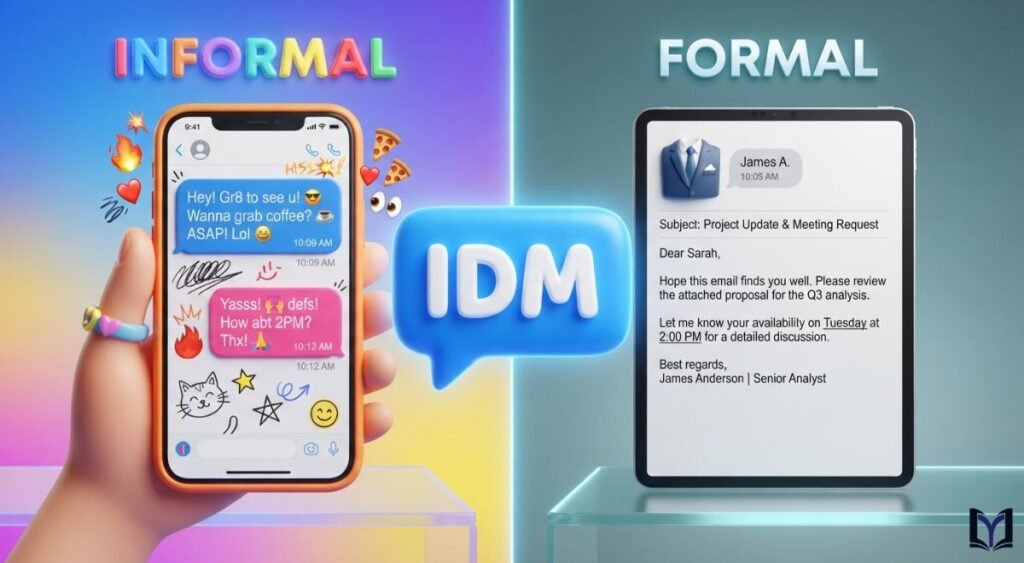
So, is IDM slang? Yes, in the texting sense, IDM works as a casual slang abbreviation. It belongs to the wider world of digital shorthand used in chats and social platforms. You may see it in private messages, group chats, comments, and casual texts. The term feels natural among people who already use texting slang. It does not usually belong in formal writing. A school paper, business proposal, or official email needs clearer language.
Understanding IDM formal or informal usage can save you from awkward wording. Imagine sending your manager, “IDM about the deadline.” The sentence may be understood, yet it sounds too casual and slightly vague. A better version would say, “I don’t have a preference about the deadline,” or “Either option works for me.” The point is not that IDM is wrong. It simply belongs in the right environment.
Is IDM Appropriate for Work or School?
For casual workplace chats, IDM may sometimes appear between colleagues who know each other well. In formal emails or academic writing, full phrases usually work better. Your audience should guide your language choices.
Better Alternatives to IDM in Formal Messages
Formal alternatives include “I don’t have a preference,” “Either option works for me,” and “I am flexible.” These phrases communicate the same idea with a more polished tone. They also reduce the risk of confusion.
When “I Don’t Mind” Sounds More Natural
Even in casual conversations, writing out “I Don’t Mind” can sometimes sound warmer. This works especially well when the conversation feels personal or when the other person may not recognize texting abbreviations.
Other Meanings of IDM and Similar Texting Acronyms
Outside IDM meaning in text, the acronym can describe several unrelated ideas. In technology, Internet Download Manager refers to download software. In electronic music, Intelligent Dance Music names a genre associated with experimental electronic sounds. In business and cybersecurity, Identity Management deals with managing digital identities and access. These meanings have nothing to do with “I Don’t Mind.” The surrounding subject tells you which definition fits. That is why other meanings of IDM matter when researching the acronym.
It also helps to compare IDM with similar texting terms. IDM vs IDC meaning is especially important because the phrases look close while the tone can differ. IDC means “I Don’t Care.” Depending on context, that can sound more dismissive. Other common alternatives include “No Problem,” “Either works,” “Up to you,” “No preference,” and “I’m flexible.” Each phrase carries a slightly different shade of meaning. Choosing the right one helps you sound clear, polite, and natural.
Other Meanings of IDM
The main alternative meanings of IDM include Internet Download Manager, Intelligent Dance Music, and Identity Management. You may encounter each term in a different field. The topic surrounding the acronym usually makes the intended meaning clear.
IDM as “Internet Download Manager”
Internet Download Manager is a software term associated with managing internet downloads. When IDM appears in a technology discussion about files or download performance, this meaning becomes far more likely than “I Don’t Mind.”
IDM as “Intelligent Dance Music”
Intelligent Dance Music refers to a style of electronic music. A music fan discussing artists, albums, or electronic genres may use IDM in this sense. The conversation itself provides the clue.
IDM vs IDC, IDK, IMO, and Other Texting Acronyms
| Acronym | Meaning | Typical Tone | Common Use |
| IDM | I Don’t Mind | Neutral, flexible | Choices and suggestions |
| IDC | I Don’t Care | Can sound dismissive | Lack of concern |
| IDK | I Don’t Know | Uncertain | Questions and answers |
| IMO | In My Opinion | Neutral | Sharing opinions |
| NP | No Problem | Friendly | Accepting or reassuring |
| YW | You’re Welcome | Polite | Responding to thanks |
Knowing these differences helps you avoid sending the wrong signal. IDM generally means you are okay with the available choices. IDC can suggest that you simply do not care. That small distinction matters in online communication, where tone can easily get lost.
Related Slang Terms You Should Know
Texting language changes quickly. Once you understand IDM, terms such as IDK, IDC, IMO, TBH, and NP become easier to recognize. These texting abbreviations all save space while carrying a specific conversational meaning. Learning them helps you follow modern social media slang without constantly stopping to decode every message.
Final Thoughts
The most common IDM meaning in texting is “I Don’t Mind.” People use it when they have no preference, feel comfortable with a suggestion, or want someone else to make the final choice. You will often see the term in casual texting, Snapchat, Instagram, group chats, and other forms of digital communication. In many situations, it signals agreement, acceptance, and flexibility without demanding extra explanation. That makes IDM a handy piece of modern shorthand.
Still, context remains the golden rule. If a technology article mentions IDM, it may mean Internet Download Manager. A music discussion may point to Intelligent Dance Music. A business or security conversation may refer to Identity Management. Once you know the setting, the meaning becomes much easier to decode. When someone asks, what does IDM mean from a girl or what does IDM mean from a guy, the basic answer usually stays the same. The surrounding conversation matters more than the sender’s gender. In everyday texting, IDM normally means “I Don’t Mind.” That simple phrase can keep a conversation moving without making a small choice feel like a major decision.
FAQ’s About What Does Idm Mean In Text
What does IDM mean in text?
IDM usually means “I Don’t Mind.” It shows that you’re okay with a choice or have no strong preference.
What does it mean if a girl says IDM?
If a girl says “IDM,” she usually means “I Don’t Mind” and is comfortable with the option or suggestion.
What does IDM stand for?
In texting, IDM stands for “I Don’t Mind.” It can have other meanings in technology or music depending on the context.
What does IDM mean in Gen Z?
In Gen Z texting, IDM commonly means “I Don’t Mind.” It’s a casual way to show flexibility or acceptance.
What does IDM mean in slang terms?
As texting slang, IDM means “I Don’t Mind.” People use it in casual chats when they don’t have a preference.
Related Articles: ION Mean in Text? Meaning, Slang, Contexts, Example & Usage

Welcome to Meanings There! I’m the creator and author behind this website, sharing useful meanings, explanations, and informative content to make words and phrases easier to understand.
1 thought on “What Does IDM Mean in Text? Meaning, Uses, Examples & More”