

Have you ever received a text that says “IDC” and wondered what the sender really meant? If you’re asking what does idc mean in text, the answer is usually “I Don’t Care.” This popular abbreviation appears in text messages, chats, social media posts, and everyday online conversations. However, IDC isn’t always as blunt as it looks. Depending on the tone of the message, it can show no preference, playful indifference, frustration, or even a dismissive attitude.
For example, “IDC where we eat” may simply mean you can choose the restaurant. In contrast, “IDC anymore” can sound emotionally distant. Understanding the surrounding conversation helps you interpret IDC accurately.
What Does IDC Mean in Text?
So, what does IDC mean in text? IDC usually means “I Don’t Care.” It is an initialism made from the first letters of “I,” “Don’t,” and “Care.” The IDC text meaning usually shows that something isn’t important to the sender. It can also mean that the sender has no strong opinion about a choice. For example, if someone asks, “Pizza or tacos?” and you answer “IDC,” you may simply mean that both sound good. In this case, the IDC casual meaning is relaxed rather than rude. The phrase is common in text messages, DMs, group conversations, and other forms of informal communication.
The I Don’t Care meaning can also carry more emotional weight. A message such as “IDC anymore” may suggest frustration, disappointment, or emotional detachment. Likewise, “IDC what they think” can express confidence or a strong sense of independence. Therefore, IDC meaning in text messages depends on more than the three letters alone. You should consider the surrounding words, punctuation, emojis, and the overall conversation. A simple “IDC 😂” may feel playful. A plain “IDC.” may feel much colder. The words stay the same, but the intended meaning can shift.
Quick Meaning of IDC in Text
The short answer to what does IDC mean in a text message is “I Don’t Care.” It can communicate not concerned, doesn’t matter, not important, no preference, or a simple casual response. For example, “IDC where we go” often means “You can choose.” That is very different from “IDC about your opinion,” which can sound more dismissive.
| Term | Meaning | Common Tone | Usage |
| IDC | I Don’t Care | Casual, neutral, playful, or dismissive | Informal communication |
| IDC lol | I Don’t Care | Light or playful | Casual chats |
| IDC anymore | I Don’t Care anymore | Emotional or detached | Personal conversations |
| IDC what you think | I Don’t Care what you think | Confident or dismissive | Opinions and disagreements |
Is IDC a Texting Slang Abbreviation?
Yes. IDC slang is a form of internet slang and texting shorthand. It is an internet abbreviation that helps people communicate quickly. The I Don’t Care abbreviation works well in short digital messages because most frequent texters recognize it immediately. It is not normally used in formal writing.
Related Articles: What Does Fien Mean? Slang Meaning, Definition & Examples
What Does IDC Stand For?
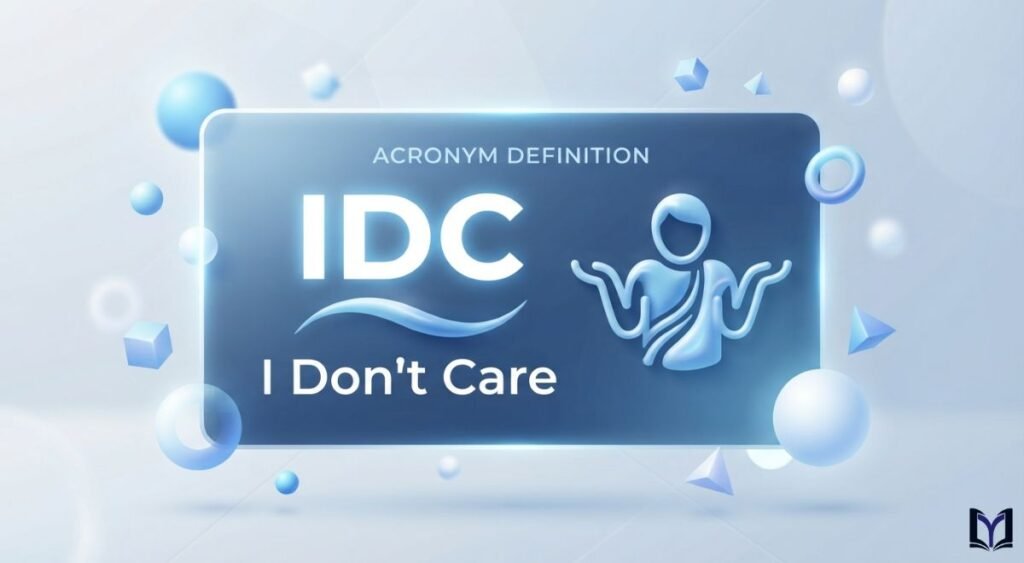
What does IDC stand for? It stands for “I Don’t Care.” The IDC full form comes directly from the first letters of the three words. In everyday texting, the phrase can mean that someone has no preference, feels indifferent, or doesn’t want to spend more time discussing a subject. The I Don’t Care in text meaning is therefore flexible. A person may use it simply because they don’t mind a particular choice. Someone else may use it to end an argument or show that another person’s opinion doesn’t affect them. This makes IDC a useful but sometimes blunt texting abbreviation.
The I Don’t Care slang version is especially common in casual digital communication. You may see it in private messages, group chats, social media posts, comments, and gaming conversations. It can save time when a longer sentence would add little value. For example, “IDC which movie we watch” is faster than typing “I don’t care which movie we watch.” However, speed isn’t the only reason people use it. The phrase can also add attitude. Depending on the conversational context, IDC may sound relaxed, confident, sarcastic, frustrated, or dismissive.
IDC Full Form and Simple Definition
The IDC acronym means “I Don’t Care.” In simple English, it can mean “it doesn’t matter to me,” “I’m not concerned about it,” or “you can choose.” The exact meaning depends on what comes before and after the abbreviation. That is why understanding IDC usage requires more than memorizing its full form.
What Does “I Don’t Care” Mean in a Conversation?
The phrase “I don’t care” doesn’t always mean a person feels nothing. Sometimes it means they have no preference. At other times, it signals lack of interest or lack of concern. For example, “I don’t care where we eat” can mean either restaurant works. “I don’t care what happens anymore” carries a much stronger emotional message.
How Is IDC Used in Text Messages and Chats?
IDC in texting usually appears in casual conversations. People may use it while making plans, answering questions, discussing opinions, or reacting to something that doesn’t matter to them. A friend might ask, “Do you want to go at six or seven?” You could reply, “IDC, either works.” Here, IDC communicates lack of preference rather than anger. This is one of the most common forms of IDC in chat. The sender isn’t rejecting the conversation. They simply don’t have a strong opinion. In this situation, IDC meaning in chat is close to “I’m fine with whatever you choose.”
However, a short IDC can become a dismissive response when someone expects emotional attention. Imagine a friend saying, “I worked all night on this project. What do you think?” A reply of “IDC” may feel hurtful. The sender may read it as a rude response because the message ignores the effort behind the question. This is why IDC meaning in texting depends heavily on context. The same abbreviation can work perfectly during a dinner decision yet sound harsh during a serious conversation. Digital communication removes facial expressions and vocal cues, so small details often carry extra weight.
IDC as a Casual Response
In casual communication, IDC often means that the sender has no strong preference. “IDC, you pick” is a good example. The person may genuinely be happy with either option. Here, the IDC casual meaning is relaxed and practical.
IDC as a Dismissive Response
A bare “IDC” can become a dismissive attitude when someone uses it to reject another person’s concern. “I worked hard on this” followed by “IDC” can sound much colder than “I’m not really worried about it.” The context makes the difference.
IDC in Emotional Conversations
In an emotional conversation, IDC may suggest frustration or distance. Phrases such as “IDC anymore” can indicate that the speaker no longer wants to discuss something. Still, you shouldn’t automatically assume what the person feels. Look at the rest of the conversation first.
IDC Meaning on Instagram, TikTok, Snapchat & Other Social Media

The IDC meaning in social media usually remains “I Don’t Care.” However, the way people use it varies between platforms. The IDC meaning on social media may appear in DMs, captions, comments, Stories, memes, and replies. On Instagram, someone might write “IDC what people think” under a photo. On TikTok, a creator may use IDC in a humorous caption. Snapchat users often use it in fast private messages. WhatsApp users may use it in both one-on-one and group chats. Across these platforms, the core meaning remains stable. The surrounding content gives the phrase its emotional color.
The IDC social media meaning can also become playful or sarcastic. A person may write “IDC 😂” after making an obviously silly choice. In that setting, the emoji softens the statement. TikTok comments may use IDC as part of a joke or trend. Instagram captions may use it to express confidence. Snapchat messages often keep it short because conversations move quickly. Therefore, IDC meaning on Instagram, IDC meaning on TikTok, IDC meaning on Snapchat, and IDC meaning on WhatsApp all share the same basic definition. Their presentation can still feel different.
| Platform | Common Use | Example | Likely Impression |
| Private and group chats | “IDC, you choose.” | Casual | |
| DMs, captions, comments | “IDC what they think.” | Confident or indifferent | |
| TikTok | Comments and captions | “IDC 😂 I’m posting it.” | Playful |
| Snapchat | Quick replies | “IDC lol.” | Casual |
| Posts and comments | “IDC anymore.” | Context-dependent | |
| X | Replies and posts | “IDC what people say.” | Confident or dismissive |
IDC Meaning on Instagram and TikTok
The IDC meaning on Instagram often appears when someone expresses confidence about an opinion, outfit, post, or personal choice. On TikTok, what does idc mean on TikTok often has a similar meaning. The abbreviation may appear in humorous videos, comments, captions, or reactions.
IDC Meaning on Snapchat and WhatsApp
The IDC meaning on Snapchat usually appears in quick, informal exchanges. The same applies to the IDC meaning on WhatsApp. An emoji, “lol,” or extra phrase can make the message feel less blunt.
IDC in Comments, Captions, and Online Posts
In public posts, IDC can express a strong “I’m doing what I want” attitude. For example, “IDC what people think about my style” communicates independence. The phrase may sound confident rather than careless when the surrounding content supports that reading.
What Does IDC Mean Depending on Tone and Context?
The biggest clue in IDC tone is the situation surrounding the abbreviation. A neutral message such as “IDC, either one works” communicates no strong opinion. A message such as “IDC. Stop asking” has a stronger dismissive attitude. Meanwhile, “IDC 😂” can suggest a playful response between friends. These examples show why IDC context matters. Text doesn’t carry voice, facial expression, or body language. Readers must often infer those missing signals from wording, punctuation, and timing. Even a period can make a short abbreviation feel more final.
The tone of the message also depends on the relationship between the people involved. Close friends may use IDC casually without causing offense. A stranger, coworker, or romantic partner may interpret the same words differently. The emotional context matters too. During a serious conversation, IDC may feel more distant than it would during a discussion about dinner. When interpreting what does IDC mean when texting, avoid treating every use as identical. Think of IDC like a blank canvas. The conversation around it supplies the color.
Neutral or Casual IDC
A neutral tone often appears when the sender has no preference. “IDC where we eat” can simply mean that either restaurant works. In this case, IDC means either option is fine.
Rude or Dismissive IDC
A rude IDC meaning can appear when someone uses the abbreviation to reject another person’s feelings or question. “IDC” after someone shares important information may feel like a dismissive response.
Playful or Sarcastic IDC
A sarcastic tone can make IDC humorous. Friends sometimes exaggerate their indifference for comedy. For example, “IDC 😂 I’m eating the whole pizza” may be playful rather than genuinely uncaring.
Emotional IDC
In an emotional situation, IDC can suggest emotional detachment or frustration. “IDC anymore” may carry more weight than “IDC which show we watch.” The surrounding conversation helps reveal the difference.
IDC Meaning With Real Texting Examples
Real conversations make IDC examples easier to understand. Consider a friend asking, “Pizza or burgers?” A response such as “IDC, you pick” usually communicates no preference. The sender doesn’t reject either option. They simply don’t care which one happens. This is a common IDC texting example because it shows the most ordinary use. Another example could be “IDC what movie we watch tonight.” Again, the person may be perfectly relaxed. They have handed the choice to someone else. These are examples of IDC conversation examples where the phrase isn’t necessarily negative.
Now consider a different situation. Someone says, “I spent hours working on this and you didn’t even look at it.” If the reply is simply “IDC,” the message can feel much harsher. Here, the IDC slang meaning moves toward dismissal. A similar shift happens with “IDC anymore,” which can suggest that the speaker feels tired of a subject. Therefore, IDC examples should always include context. Looking only at the abbreviation can lead to the wrong interpretation.
| Situation | Example | Likely Meaning |
| Choosing food | “IDC, you pick.” | No preference |
| Choosing a movie | “IDC what we watch.” | Either option works |
| Discussing opinions | “IDC what they think.” | Their opinions don’t matter to me |
| Joking with friends | “IDC 😂 I’m doing it.” | Playful confidence |
| Ending an argument | “IDC. I’m done.” | Dismissal or frustration |
| Emotional situation | “IDC anymore.” | Possible emotional distance |
IDC When Making Plans
When someone uses IDC while making plans, the meaning is often simple. “IDC if we go Friday or Saturday” usually means both options work. In this setting, IDC usage is practical rather than hostile.
IDC When Someone Asks for Your Opinion
If someone asks, “Which color do you like?” and you answer “IDC,” you may mean that you don’t have a strong preference. Adding “you choose” can make the meaning clearer and friendlier.
IDC in Arguments or Serious Conversations
During an argument, IDC can sound much stronger. “IDC what you say” may communicate rejection rather than neutrality. The subject, relationship, and previous messages all affect the interpretation.
IDC With Emojis and Extra Words
Extra words can soften or sharpen IDC. “IDC lol” may sound relaxed, while “IDC. Whatever.” may sound annoyed. Emojis can also provide clues about whether the sender intends humor or seriousness.
Is IDC Rude, Mean or Offensive?
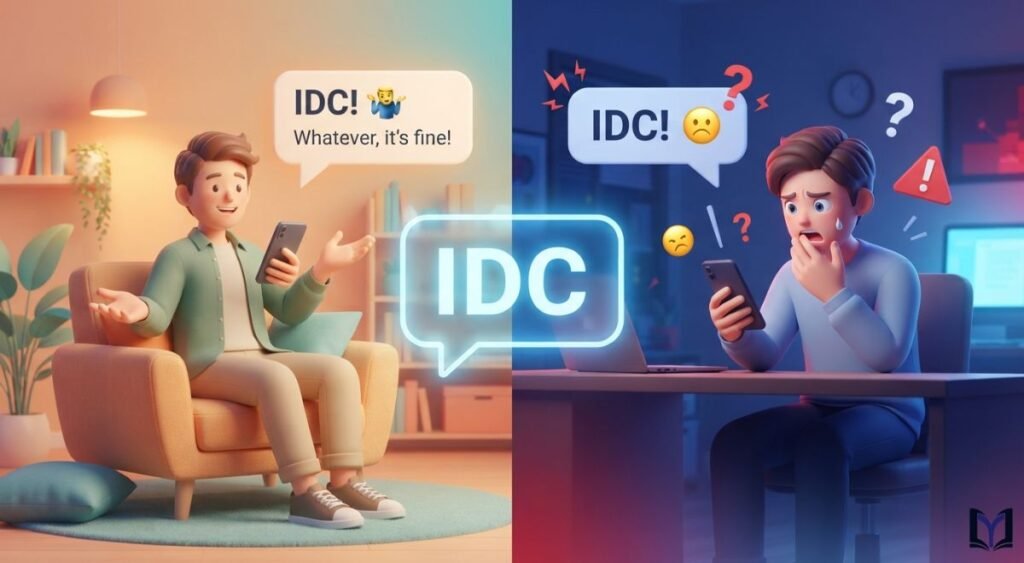
Is IDC rude in texting? Sometimes, but not always. IDC isn’t automatically rude. The phrase can be completely harmless when someone has no preference. “IDC, you choose 😊” sounds different from “IDC. Leave me alone.” The first message gives the other person freedom to decide. The second clearly pushes the conversation away. Therefore, IDC rude meaning depends on context, wording, and delivery. It is also worth remembering that people have different communication styles. One person may see IDC as normal common texting slang. Another may find it too blunt.
Is IDC a bad word? No. IDC itself isn’t a profanity. However, “I Don’t Care” can sound insensitive when someone is sharing something important. It can also become inappropriate in formal settings. A workplace email saying “IDC which option you choose” may appear careless or unprofessional. A clearer alternative would be “Either option works for me.” In sensitive conversations, a little extra wording can prevent unnecessary friction. The goal isn’t to avoid IDC completely. It is to use it where its tone fits.
When IDC Sounds Polite or Harmless
IDC can sound harmless when the topic involves personal preference. “IDC where we go for lunch” usually means the sender is flexible. Adding “you choose” makes the intention even clearer.
When IDC Sounds Rude
IDC can sound rude when it dismisses another person’s feelings, effort, or concern. A bare abbreviation can feel especially cold during a serious conversation. A fuller sentence often prevents that misunderstanding.
Can You Use IDC at Work?
IDC usually belongs in casual communication, not formal professional writing. Instead of “IDC,” a workplace message can say, “Either option works for me,” “I don’t have a preference,” or “I’m fine with whichever you choose.”
How to Respond When Someone Says IDC
Knowing how to respond to IDC starts with identifying the tone. If someone says, “IDC, you choose,” you probably don’t need to analyze the message. You can simply make the decision. If someone says “IDC” during an argument, the situation requires more care. Asking a short follow-up question can clarify whether the person means genuine indifference or frustration. A useful IDC response might be, “Do you mean you don’t mind, or are you upset about it?” That question avoids guessing and gives the sender room to explain.
When deciding how to reply to IDC, match your response to the relationship and situation. A close friend may appreciate humor. A serious conversation may need a calm answer. If the message sounds dismissive, don’t automatically respond with another harsh phrase. Clear communication usually works better. For example, “Okay, I’ll choose” works well when the sender has no preference. If the situation feels tense, “I want to make sure I understand what you mean” can keep the conversation open without adding drama.
| IDC Situation | Possible Reply | Why It Works |
| No preference | “Okay, I’ll choose.” | Keeps things simple |
| Casual chat | “Fair enough.” | Friendly and relaxed |
| Friend joking | “Wow, so much enthusiasm 😂.” | Matches playful energy |
| Serious discussion | “Are you upset, or do you just not mind?” | Clarifies the tone |
| Work conversation | “Understood. I’ll make the decision.” | More professional |
Casual Responses to IDC
For a casual IDC response, simple replies work best. “Okay, you choose,” “No worries,” or “Fair enough” can keep the conversation moving without overthinking the abbreviation.
Funny Responses to IDC
A funny reply can work when the relationship supports humor. “Wow, such enthusiasm 😂” can turn a flat message into a playful exchange. Humor should still match the conversation.
What to Say if IDC Sounds Serious
If IDC feels cold or emotional, clarification is usually safer than guessing. Asking, “Are you saying you don’t mind, or are you upset?” can reveal the sender’s actual intention.
IDC vs Similar Texting Slang and Abbreviations
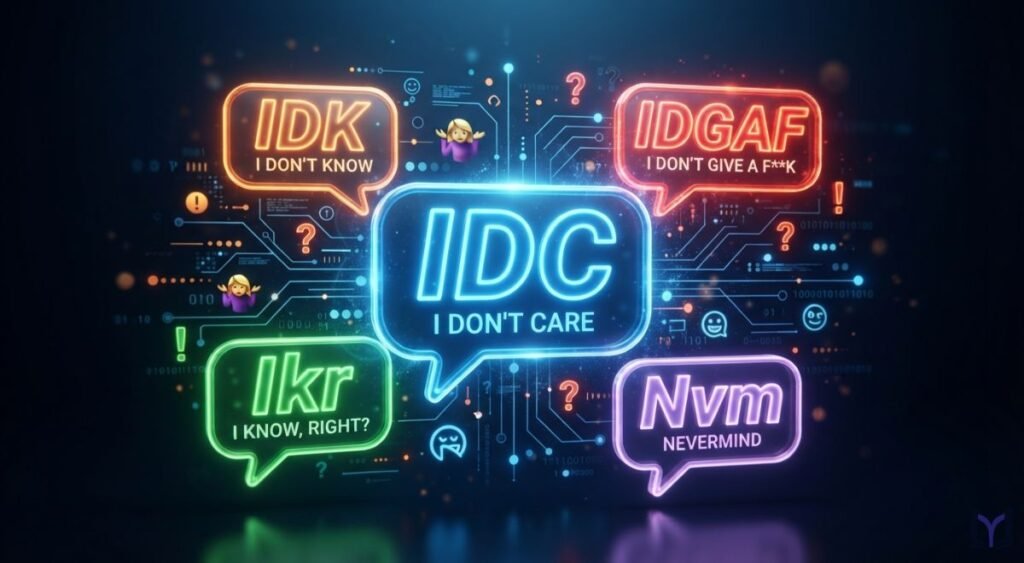
Several forms of IDC online slang look or feel similar to other texting expressions. However, their meanings aren’t identical. IDK means “I Don’t Know,” while IDC means “I Don’t Care.” One expresses uncertainty. The other expresses indifference or lack of concern. IDGAF carries a much stronger and more explicit tone than IDC. NVM means “Never Mind,” while TBH means “To Be Honest.” IKR means “I Know, Right?” These distinctions matter because replacing one abbreviation with another can completely change a message.
Understanding these differences also makes IDC meaning in chat easier to recognize. If someone writes “IDK where to go,” they are unsure. If they write “IDC where we go,” they are saying the choice doesn’t matter to them. If they write “IDGAF where we go,” the message is considerably stronger. These aren’t interchangeable expressions. Each one carries its own level of meaning and tone.
| Slang | Full Meaning | Main Idea | Typical Tone |
| IDC | I Don’t Care | Indifference or no preference | Casual to dismissive |
| IDK | I Don’t Know | Uncertainty | Neutral |
| IDGAF | I Don’t Give a F*** | Strong indifference | Strong or vulgar |
| NVM | Never Mind | Drop the subject | Casual |
| TBH | To Be Honest | Introduces honesty | Casual |
| IKR | I Know, Right? | Agreement | Casual |
| Whatever | Depends on context | Indifference or dismissal | Casual to dismissive |
IDC vs IDK
IDC vs IDK is one of the easiest texting distinctions to remember. IDC means “I Don’t Care.” IDK means “I Don’t Know.” Saying “IDC which movie we watch” means the choice doesn’t matter. Saying “IDK which movie we should watch” means you don’t know which one to choose.
IDC vs IDGAF
IDC and IDGAF both can express indifference, but IDGAF is much stronger. The latter contains profanity and can sound aggressive. For everyday casual communication, IDC is generally less forceful.
IDC vs NVM, TBH, IKR and “Whatever”
NVM tells someone to disregard something. TBH introduces an honest statement. IKR expresses agreement. “Whatever” can communicate indifference or dismissal depending on the context. IDC specifically communicates “I Don’t Care.”
Related Articles: What Does Fien Mean? Slang Meaning, Definition & Examples
Common Mistakes and Misunderstandings About IDC
One major mistake is assuming that IDC always means anger. It doesn’t. Someone may use it because they genuinely have no preference. Another mistake involves confusing IDC with IDK. These abbreviations express different ideas. A third mistake is ignoring surrounding words and punctuation. “IDC, you choose 😊” can sound friendly. “IDC.” may feel much more final. Even capitalization and emojis can affect the perceived tone. These details matter because digital messages lack many of the cues found in face-to-face conversations.
Another common problem occurs when people use IDC in a serious conversation without realizing how it might sound. A person may intend “I’m not worried about that,” yet the recipient may hear “Your feelings don’t matter.” That gap between intended and perceived meaning causes many texting misunderstandings. If a topic is sensitive, adding a few words can help. Instead of “IDC,” you might say, “I don’t mind either way.” Instead of “IDC what you think,” you could say, “Everyone can have their opinion.” Small changes can make digital communication much clearer.
| Common Mistake | What Can Happen | Better Approach |
| Assuming IDC always means anger | You may misread a casual reply | Check the context |
| Confusing IDC with IDK | The message gets the wrong meaning | Remember care vs knowledge |
| Using IDC in a serious discussion | It may sound dismissive | Add clarifying words |
| Using IDC professionally | It can seem too informal | Use a complete sentence |
| Ignoring punctuation | Tone may be misunderstood | Read the whole message |
| Ignoring emojis | Humor may be missed | Consider the complete message |
Assuming IDC Always Means Anger
IDC doesn’t automatically signal anger. The sender may simply have lack of concern about a choice. For example, “IDC, any restaurant works” is usually neutral.
Confusing IDC With IDK
IDC means “I Don’t Care.” IDK means “I Don’t Know.” The difference is simple but important. One describes concern or preference. The other describes knowledge.
Ignoring Context and Tone
The conversational context often tells you more than the abbreviation itself. Read the messages around IDC before deciding whether it sounds friendly, serious, sarcastic, or dismissive.
Is IDC Still Used in Texting and Online Culture?

Yes, IDC remains familiar in modern digital communication. The phrase continues to work because it is short, recognizable, and flexible. People use IDC internet slang in online communication, text messages, private chats, group chats, comments, captions, and gaming conversations. It fits the fast pace of modern texting. Three letters can replace an entire sentence. That efficiency is one reason IDC texting slang remains useful. Even when new slang appears, older abbreviations can stay relevant because people already understand them.
The broader role of IDC in online culture also explains its flexibility. Social media users may use it to express confidence, humor, sarcasm, or genuine indifference. The same phrase can appear in memes and everyday messages without needing a new definition. However, frequency doesn’t make it suitable for every setting. IDC usage remains informal. Formal emails, academic papers, business documents, and professional correspondence generally benefit from complete and respectful wording. Knowing where a slang term fits is just as important as knowing what it means.
Why IDC Remains Common Online
IDC remains useful because it is short and widely recognizable. It works especially well when someone wants to communicate not bothered, doesn’t matter, or no preference without writing a longer sentence.
Where You May Still See IDC
You may encounter IDC in text messages, private chats, group chats, Instagram DMs, TikTok comments, Snapchat messages, WhatsApp conversations, gaming chats, social media captions, and online forums. Its exact tone still depends on the conversation.
Conclusion
So, what does IDC mean in text? In most texting and social media situations, IDC means “I Don’t Care.” It is a common IDC abbreviation, IDC acronym, and piece of internet slang used to express indifference, lack of concern, lack of interest, or lack of preference. Sometimes it simply means either option is fine. In other cases, it can sound dismissive, sarcastic, or emotionally distant. The difference comes from the situation, relationship, wording, and tone.
The easiest way to understand IDC meaning in text is to read beyond the three letters. Look at the surrounding words, punctuation, emojis, and the overall emotional context. “IDC, you choose” usually sounds casual. “IDC anymore” may sound emotionally heavier. Likewise, knowing how to respond to IDC depends on what the sender actually means. When the tone is unclear, a quick clarification can prevent a small abbreviation from turning into a big misunderstanding.
FAQ’s About What Does Idc Mean In Text
What does IDC mean in text?
IDC usually means “I Don’t Care.” It shows indifference, no preference, or a lack of concern.
Is IDC a rude word?
IDC isn’t automatically rude, but it can sound dismissive or harsh depending on the context and tone.
Is “IDC” a Gen Z saying?
IDC is commonly used by Gen Z and other age groups in casual texting and social media conversations.
What does “IDC” mean in slang?
In slang, IDC means “I Don’t Care.” People use it to express indifference or say something doesn’t matter to them.
Is IDC mean I don’t care?
Yes. IDC is a common texting abbreviation for “I Don’t Care.”
Related Articles: What Does Fien Mean? Slang Meaning, Definition & Examples

Welcome to Meanings There! I’m the creator and author behind this website, sharing useful meanings, explanations, and informative content to make words and phrases easier to understand.
1 thought on “What Does IDC Mean in Text? Meaning, Uses, Examples & More”