

If you’ve ever received a message containing “DK” and wondered what it means, you’re not alone. This tiny abbreviation can look confusing when you first see it. In most casual conversations, DK slang means “Don’t Know.” People use it in text messages, social media chats, gaming communities, and everyday conversations when they aren’t sure about something.
You may also see it used alongside IDK, although the two expressions have a slight difference in tone. However, what does DK mean can depend on the situation. DK may have other meanings in gaming, geography, or specialized fields. This guide explains its meaning, common uses, examples, and the best ways to respond naturally.
What Does DK Mean in Text and Chat?
So, what does DK mean in text? In most cases, DK means Don’t Know. People use it when they feel uncertain about an answer, don’t have the information, or simply want to reply quickly. It works as a text message abbreviation that saves typing without changing the basic idea of the response. For example, if someone asks, “What time does the movie start?” you might reply, “DK, check the website.” The meaning is clear from the question and the surrounding conversation. Slang references specifically describe DK as an abbreviation used in text messaging and online chat when someone doesn’t know an answer.
The tone can change slightly depending on who sends it. A friend who texts “DK lol” probably sounds relaxed. A stranger who replies with only “DK” may sound more blunt. That difference matters because digital messages don’t carry facial expressions or vocal tone. You often need to read the whole exchange before judging the person’s attitude. In everyday casual conversations, DK usually feels like a casual texting abbreviation rather than anything serious. It tells you the person doesn’t have an answer without requiring a full sentence.
Is DK the Same as “Don’t Know”?
Yes. In ordinary texting, the Don’t Know meaning is the most common interpretation of DK. It can function as a quick standalone response or appear beside other words. For example, “DK where he went” means “I don’t know where he went.” The phrase is deliberately clipped. It removes unnecessary words while keeping the main idea intact.
DK Meaning in Chat, Texting, and Social Media
The DK chat meaning stays fairly consistent across most messaging platforms. You can encounter dk in texting, dk in chat, and dk online slang when someone doesn’t know something. People may use it in WhatsApp, Snapchat, Instagram, TikTok, Facebook Messenger, or Discord. It can also appear in gaming chats, gaming lobbies, and online discussions. The platform usually doesn’t change the basic meaning. The subject of the conversation does.
This makes DK a useful example of how texting slang works. Digital conversations often favor shorter expressions because people want fast responses. A person may type “DK” instead of “I don’t know” when the answer isn’t important enough to justify a longer message. Still, brevity can affect tone. “DK” may sound neutral between close friends. In a professional conversation, the same response could seem careless. The abbreviation therefore works best when you understand the relationship and situation first.
| Context | Likely DK meaning | Typical tone |
| Friend’s text | Don’t Know | Casual |
| Group chat | Don’t Know | Informal |
| Gaming chat | Don’t Know or Donkey Kong | Context-dependent |
| Social media DM | Don’t Know | Casual |
| Workplace message | Don’t Know | Can sound too brief |
| Gaming discussion about Nintendo | Donkey Kong | Topic-specific |
| Website ending in .dk | Denmark | Geographic |
DK Full Form in Chat
The DK full form in chat is Don’t Know. It acts as a dk abbreviation for a phrase people commonly use in everyday communication. Instead of typing “I don’t know,” someone may simply write “DK.” The shorter form works especially well when the conversation moves quickly. You can think of it like trimming a sentence down to its essential meaning.
There is an important distinction, though. I Don’t Know and Don’t Know communicate nearly the same idea, yet they aren’t written the same way. The first includes the subject “I.” The second drops it. That difference explains why DK full meaning is generally understood as “Don’t Know,” while IDK directly represents “I Don’t Know.” Reference sources list DK as a text-messaging abbreviation for “don’t know.”
Related Articles: What Does MYB Mean in Text? Meaning, Slang, Examples & More
Why Does DK Mean “Don’t Know”?
The abbreviation follows a simple shortening pattern. “Don’t” gives you D, while “Know” gives you K. Put the two together and you get DK. Unlike many newer slang expressions, the meaning doesn’t require much decoding when the surrounding question is clear.
DK vs IDK: What’s the Difference?
The dk vs idk question comes up often because both expressions communicate uncertainty. IDK means I Don’t Know, while DK means Don’t Know. Wiktionary lists IDK as an Internet slang and text-messaging abbreviation for “I don’t know” and identifies DK as a related form meaning “don’t know.” In practical texting, both can answer a question such as “Where is Jake?” However, IDK usually sounds more complete because it explicitly includes “I.”
The difference becomes more noticeable in tone than in meaning. “IDK” often feels natural and conversational. “DK” can feel more clipped because it removes the subject. Neither one automatically sounds rude. Your relationship with the other person matters more. If you are chatting with a close friend, “DK lol” may feel perfectly normal. In a serious conversation, “I’m not sure” may communicate more care and clarity.
| Expression | Full form | Meaning | Typical impression |
| DK | Don’t Know | You don’t know | Short and clipped |
| IDK | I Don’t Know | You don’t know | Casual and familiar |
| I’m not sure | Full phrase | You lack certainty | Clear and polite |
| I’ll check | Full phrase | You will find the answer | Helpful and proactive |
Which One Should You Use: DK or IDK?
For ordinary texting, either can work. If you want the message to feel more natural and recognizable, IDK is often the safer choice. Use DK when the conversation already feels highly informal and the other person understands common texting abbreviations.
What Does DK Mean on Snapchat, Instagram, and TikTok?
If you’re wondering about dk meaning on Snapchat, it normally follows the same rule as ordinary texting. In a DM, someone might send “DK” because they don’t know the answer to your question. The same applies to dk meaning on Instagram. A person may use it in a direct message or Instagram comments when the context clearly points toward uncertainty. On TikTok, dk meaning on TikTok can also mean “Don’t Know” when it appears in a conversation. The platform itself doesn’t automatically give DK a new slang definition.
The same principle applies to dk meaning in social media more broadly. You might find DK in social media posts, comments, messages, or community conversations. DK meaning on Discord can also mean “Don’t Know” when someone answers a question in a server. However, gaming communities create an important exception. If the discussion involves Nintendo, DK may refer to Donkey Kong instead. That is why reading the surrounding words matters more than focusing on the platform name.
| Platform | Common DK meaning in casual chat | Important context |
| Snapchat | Don’t Know | Usually a quick response |
| Don’t Know | Common in DMs | |
| TikTok | Don’t Know | Context determines meaning |
| Discord | Don’t Know | Gaming context can change it |
| Don’t Know | Common in informal chats | |
| Facebook Messenger | Don’t Know | Usually conversational |
Does DK Mean Something Different on Social Media?
Usually, no. Social platforms don’t give DK one universal alternate definition. The subject of the conversation provides the clue. A message about dinner plans may use DK for “Don’t Know.” A Nintendo gaming discussion may use DK for “Donkey Kong.”
Examples of DK in Text Messages
Real conversations make the dk text meaning easier to understand. Imagine your friend asks, “Do you know what time the concert starts?” You could answer, “DK. Maybe around 8?” Here, DK clearly means Don’t Know. You could also receive a message such as, “Who’s bringing snacks?” and respond, “DK, ask Mike.” In both cases, the abbreviation tells the other person that you don’t have enough information to give a definite answer.
You can also place DK within a longer message. For example, “DK what she wants” means “I don’t know what she wants.” Another example could be, “DK if I’m going tonight.” Here, the abbreviation expresses uncertainty rather than complete ignorance. The exact wording around DK helps establish the intended meaning. This is common in casual communication, where people often leave out words that the conversation already makes obvious.
| Text example | Meaning |
| “DK.” | I don’t know. |
| “DK what time.” | I don’t know what time. |
| “DK, ask Alex.” | I don’t know. Ask Alex. |
| “DK if I can go.” | I don’t know if I can go. |
| “DK lol.” | I don’t know, with a casual tone. |
| “DK yet. I’ll check.” | I don’t know yet, but I’ll find out. |
DK Meaning in Different Conversation Contexts
Context can completely change how a short abbreviation feels. “DK” between friends can sound relaxed. “DK” after a serious question may sound dismissive. In a gaming discussion, DK could even mean Donkey Kong rather than “Don’t Know.” The words around the abbreviation provide the strongest clue.
How to Respond When Someone Sends “DK”
Knowing how to respond to dk depends on what you need from the conversation. If the person simply doesn’t know, you don’t need to make the exchange complicated. You can say, “No worries,” and move on. If you still need the information, ask, “Can you find out?” You could also say, “Any idea who might know?” These responses keep the conversation moving without making the other person feel pressured.
Related Articles: What Does MYB Mean in Text? Meaning, Slang, Examples & More
Tone deserves attention here. A one-word “DK” may be completely harmless in a relaxed conversation. However, it can feel abrupt when you ask an important question. If the topic involves plans, work, or something time-sensitive, a follow-up can help. You might say, “Okay. Can you check later?” That approach turns a dead-end answer into the next step. In other words, don’t treat every short message as a hidden attitude. Read the entire exchange first.
| Situation | Natural response |
| You don’t need the answer anymore | “No worries!” |
| You still need the information | “Can you check?” |
| You don’t know who might know | “Any idea who I should ask?” |
| The answer matters later | “Okay, let me know when you find out.” |
| The message feels unclear | “Do you mean you’re not sure?” |
What Does DK Mean When Someone Replies With Just “DK”?
A standalone “DK” usually means “I don’t know.” It may simply answer your question as quickly as possible. Don’t assume the person is annoyed just because they used two letters. Look at punctuation, previous messages, and your relationship before deciding what the tone means.
Other Meanings of DK You Should Know
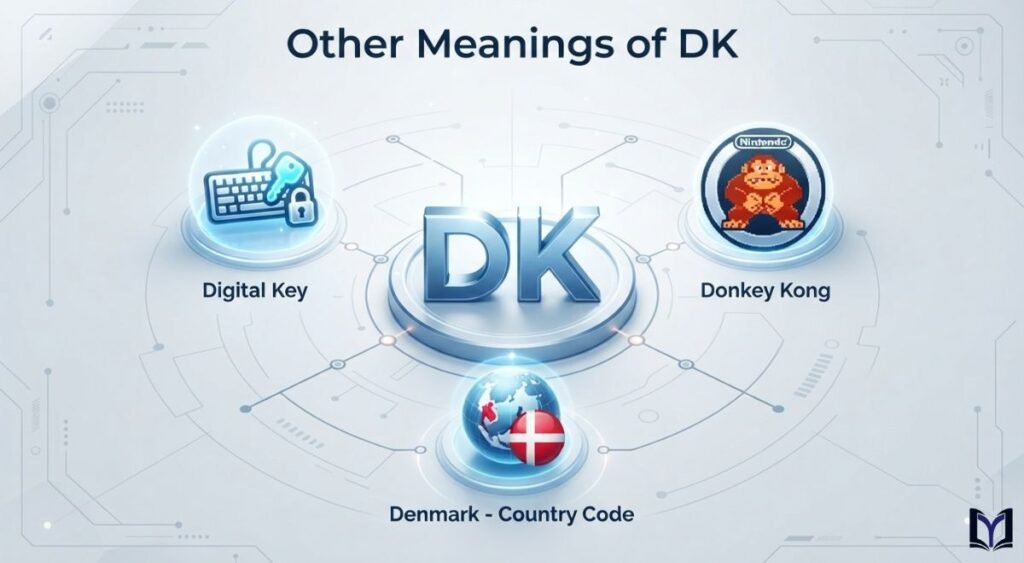
Although Don’t Know dominates casual texting, DK has several other meanings. The most familiar alternative for gamers is Donkey Kong, the Nintendo character and game franchise. If someone says, “DK is the best character,” while discussing Nintendo, they almost certainly aren’t saying “Don’t Know.” They are using DK as a gaming initialism. Wiktionary lists Donkey Kong as a proper-name use of DK.
Another important meaning appears outside conversations. “.dk” is the Denmark country code used for Danish internet domains. DK can also appear as Drift King in automotive or racing discussions. Some specialized fields use the letters for their own terms. For example, Donor Kidney may appear in medical contexts, while Diabetic Ketoacidosis is commonly shortened as DKA rather than DK. Acronym references show that DK can have many meanings across different fields.
| DK meaning | Where you may see it | Clue |
| Don’t Know | Texting and chat | Someone lacks an answer |
| Donkey Kong | Gaming | Nintendo or game discussion |
| Denmark country code | Websites and geography | “.dk” domain |
| Drift King | Car culture | Drifting or racing |
| Donor Kidney | Medical context | Organ or transplant discussion |
| Diabetic Ketoacidosis | Medical context | Usually written as DKA |
How Can You Tell Which DK Meaning Someone Intended?
Look at the words before and after DK. Ask what the conversation discusses. If someone asks, “Do you know where Sarah is?” then DK probably means Don’t Know. If someone says, “I finally unlocked DK,” the gaming context points toward Donkey Kong. As the saying goes, context matters.
When Should You Use or Avoid DK in a Conversation?
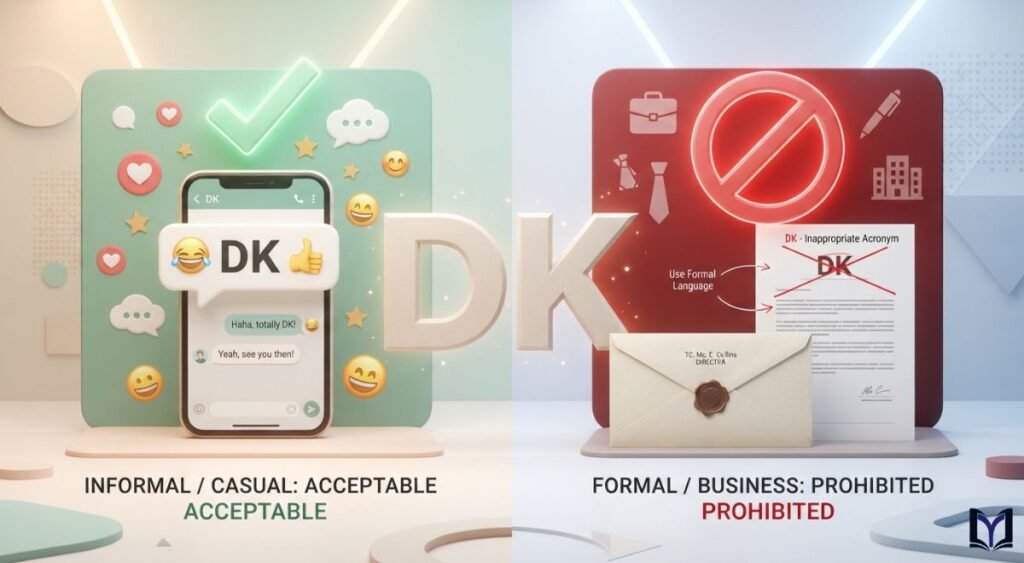
Knowing when to use dk can prevent awkward messages. DK works best in informal conversations where short replies feel normal. Friends, classmates, gaming partners, and familiar online contacts usually understand it without trouble. It can save time when the answer isn’t important or when you’re already exchanging rapid messages. That’s the main appeal of dk internet slang and other forms of online chat abbreviation. The goal is simple: communicate the idea with fewer characters.
However, there are situations when you should consider when to avoid dk. In professional conversations, workplace messages, or professional emails, a complete response usually sounds clearer. The same applies to serious conversations and sensitive conversations. If someone asks you something important, “I’m not sure, but I’ll check” shows more care than “DK.” Formal communication often benefits from complete wording because clarity matters more than saving a few keystrokes.
| Situation | DK suitable? | Better choice when clarity matters |
| Texting a close friend | Yes | DK |
| Casual group chat | Yes | DK or IDK |
| Gaming chat | Usually | DK or IDK |
| Talking to someone new | Sometimes | “I’m not sure.” |
| Workplace messages | Usually avoid | “I’ll check.” |
| Professional emails | Avoid | “I’m not sure.” |
| Serious conversations | Usually avoid | “I don’t know yet.” |
| Sensitive conversations | Avoid | A complete, thoughtful response |
Is DK Appropriate for Work or Professional Texts?
It depends on the relationship and workplace culture. Still, full wording usually creates a clearer impression. Instead of “DK,” try “I’m not sure,” “I don’t have that information,” or “I’ll check and let you know.” These alternatives sound more professional without becoming overly formal.
Conclusion
So, what does dk mean in text? In most everyday messages, DK means Don’t Know. It is a two-letter abbreviation that people use when they lack an answer or want to reply quickly. You may see it in text messages, group chats, social media, gaming communities, and other forms of digital communication. Its meaning is closely related to IDK, although dk vs idk has a small difference in wording and tone.
The bigger lesson is simple: context matters. DK may mean Don’t Know in a friend’s message, Donkey Kong in a gaming conversation, or relate to Denmark when you see “.dk.” Once you understand the surrounding topic, the meaning usually becomes obvious. For casual chats, DK can be convenient. For professional conversations, serious topics, or sensitive situations, clearer wording is often the better choice.
FAQ’s About What Does Dk Mean
What does “DK” mean?
DK usually means “Don’t Know” in texting and casual online conversations. It tells someone that you don’t know the answer.
What does DK mean in slang?
In slang, DK commonly means “Don’t Know.” People use it as a quick, informal response in chats and text messages.
What does DK DC mean in text?
DK DC can mean different things depending on context. In many chats, DK means “Don’t Know,” while DC may mean “Don’t Care” or “Discord.”
What is DK short for?
DK is most commonly short for “Don’t Know.” It works as a quick texting abbreviation.
What does DK stand for?
In texting, DK stands for “Don’t Know.” However, it can have other meanings in gaming, geography, and specialized contexts.
Related Articles: What Does MYB Mean in Text? Meaning, Slang, Examples & More

Welcome to Meanings There! I’m the creator and author behind this website, sharing useful meanings, explanations, and informative content to make words and phrases easier to understand.