

Ever received a comment that sounded friendly but felt like a tiny jab? That’s where the throw shade meaning becomes interesting. “Throw shade” describes a clever way of criticizing, mocking, or disrespecting someone without saying it directly. You’ll often notice this indirect criticism in everyday chats, funny conversations, and online posts. A person might use a sarcastic comment that seems harmless until you understand the hidden message behind it.
The phrase is common in social media comments, text messages, and casual speech, especially when people want to make a sharp point with humor. Once you understand the tone and context, recognizing subtle criticism becomes much easier.
What Does Throwing Shade Mean?
So, what does throwing shade mean in everyday English? It means making a subtle or indirect insult toward someone. The speaker may use sarcasm, humor, silence, facial expressions, or carefully chosen words. Dictionary.com describes “throw shade” as insulting, criticizing, or disrespecting a person or thing in an indirect and artful way. In other words, throwing shade is rarely a blunt attack. It works more like a hidden arrow. You may not see it immediately, but the target usually understands the point. For example, if a friend arrives forty minutes late and someone says, “Wow, nice of you to join us,” that sarcastic comment can carry a clear implied criticism. The speaker doesn’t directly say, “You’re always late.” Instead, the remark lets the listener connect the dots.
The throwing shade definition can also change slightly with the situation. Sometimes it sounds funny and harmless. Other times, it carries real disrespect. That difference depends heavily on tone and context, the relationship between the people, and the reason behind the remark. A friend might use a playful insult during a joke, while a stranger might use the same style to embarrass someone. The phrase can describe indirect language, a negative comment, or a witty remark that quietly targets another person. The easiest memory trick is simple: think about actual shade. A shadow partly hides something from direct light. In the same way, shade in slang partly hides the criticism behind humor, sarcasm, or clever wording.
| Term | Meaning |
| Throwing shade | Making an indirect insult or criticism |
| Throw shade | To criticize or disrespect someone indirectly |
| Threw shade | Past tense of throwing shade |
| Throwing shade at someone | Indirectly criticizing a particular person |
| Shade | An indirect slight, insult, or criticism |
What Does “Throwing Shade” Mean in Text and Social Media?
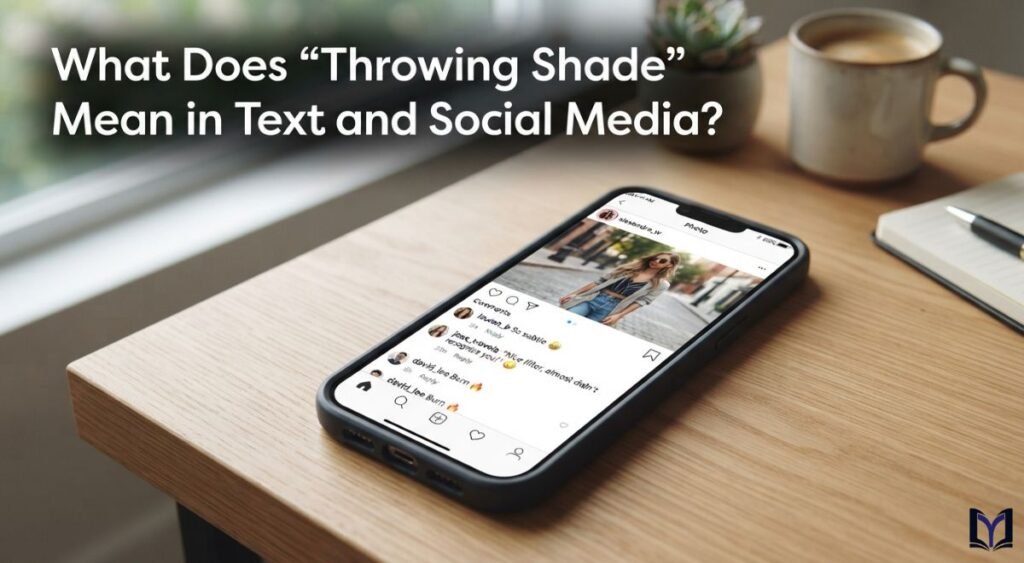
The throwing shade meaning in text stays almost the same as it does in spoken conversation. The main difference is that text removes facial expressions and voice tone. Because of that, readers often depend on emojis, punctuation, previous messages, and shared context. A message such as “Must be nice to actually finish something on time” may look like a normal statement at first. However, if someone recently missed a deadline, the implied message becomes obvious. This is a common example of throwing shade in text because the criticism remains indirect. The speaker doesn’t directly name the person or openly call them irresponsible.
Online, throwing shade on social media can appear in many forms. A person might post a vague caption, leave a pointed comment, share a meme, or reply with a sarcastic statement. Social media posts, social media comments, and social media captions can all carry shade when the audience understands who or what the message targets. You may notice throwing shade on Instagram through captions or comments. You may also see throwing shade on TikTok through videos, replies, or stitched reactions. On other platforms, people may use vague posts to criticize someone without naming them. Dictionary.com notes that the phrase is widely used in colloquial speech and digital communication, including indirect online criticism such as subtweets.
Related Articles: Bts Meaning Slang: What Does BTS Mean in Chat & Social Media?
| Online Setting | Example of Shade | Possible Hidden Meaning |
| Text message | “Glad you finally remembered.” | You forgot before. |
| Instagram caption | “Some people love attention.” | Someone is seeking attention. |
| TikTok comment | “The confidence is impressive.” | The person may lack the expected skill. |
| Social media post | “Loyalty seems rare these days.” | Someone behaved disloyally. |
Is Throwing Shade an Insult or Just a Joke?
Is throwing shade always an insult? Not necessarily. It can be a joke, playful criticism, or genuine disrespect. The difference often comes down to speaker’s tone, relationship, timing, and intention. Friends may throw shade at each other because they understand the humor behind it. For example, one friend might say, “Look who finally decided to answer the group chat.” If everyone laughs, the remark may function as playful criticism rather than a serious attack. However, the same sentence could feel harsh when said during an argument. That is why context variations matter so much when you interpret slang.
A useful comparison is the difference between a joke and a direct attack. A direct insult tells someone exactly what the speaker thinks. Shade often makes the target figure it out. A sarcastic remark, a humorous comment, or a carefully worded sentence may carry an implied insult without saying it openly. Sarcasm also doesn’t automatically equal shade. A person can use a sarcastic tone without targeting anyone. Shade usually has a recognizable target. The key question is simple: Is someone being criticized in an indirect or artful way? If yes, the phrase may fit.
| Situation | Likely Meaning |
| Close friends laughing | Playful shade |
| Public argument | Possible insult |
| Sarcastic social media caption | Possible shade |
| Constructive feedback | Usually criticism, not shade |
| Open name-calling | Direct insult |
Examples of Throwing Shade in Everyday Conversations

Real-life throwing shade examples make the phrase much easier to understand. Imagine someone constantly talks about being organized but forgets an important appointment. A friend might say, “Well, somebody clearly has their schedule under control.” The words sound positive on the surface. The hidden insult becomes clear from the situation. Another example could involve someone who brags about arriving early. If they walk in twenty minutes late and hear, “Early as always,” the speaker is using subtle criticism rather than a direct complaint. These examples of throwing shade show why context matters more than individual words.
Throwing Shade Examples in Everyday Situations
Friends might use shade when joking about each other’s habits. Coworkers might use it when discussing missed deadlines or awkward decisions. Family members may use it during playful arguments. Dating partners might use it when someone forgets an important detail. On social platforms, a creator might make a witty remark that clearly references another person without naming them. These examples show how throwing shade in conversation can range from harmless humor to genuine hostility. The difference depends on the relationship, the target of the comment, and the speaker’s tone.
| Situation | Example | What It Suggests |
| Friend arrives late | “Right on time, as usual.” | You’re often late. |
| Coworker misses a deadline | “Great timing on that submission.” | You submitted too late. |
| Friend changes plans | “Nice to know the schedule still matters.” | You ignored the plan. |
| Social media post | “Some people discover manners eventually.” | Someone behaved rudely. |
| Dating conversation | “You remembered my birthday. Progress!” | You usually forget important things. |
How Do You Use “Throwing Shade” in a Sentence?
Knowing how to use throwing shade in a sentence starts with understanding its grammar. The phrase usually appears as throw shade, throwing shade, or threw shade. You can also say someone is “throwing shade at” another person. For example, “She is throwing shade at someone in the group chat” describes an ongoing action. “He threw shade at his former teammate” describes something that already happened. These forms work best in informal language and casual speech. They sound natural in conversations, captions, comments, and entertainment writing. They may sound out of place in highly formal documents.
The phrase can also appear in questions. Someone might ask, “Are you throwing shade at me?” This question usually means, “Are you indirectly criticizing or mocking me?” You can use throw shade at someone when the target is clear. You can also use “throwing some serious shade” when the criticism feels especially sharp. In normal language usage, the phrase acts as an informal idiomatic expression rather than a literal statement about physical shade. That phrase meaning is important because the ordinary meaning of “shade” has nothing to do with insults. The slang meaning developed through a different cultural and linguistic path.
| Form | Example |
| Throw shade | “Don’t throw shade at your teammate.” |
| Throwing shade | “She’s throwing shade again.” |
| Threw shade | “He threw shade at his old rival.” |
| Throw shade at someone | “Why did you throw shade at her?” |
| Throwing some shade | “That caption is throwing some shade.” |
When Should You Use the Phrase “Throwing Shade”?
The phrase works best in casual conversation, social media, texting, entertainment, and other relaxed settings. It can add personality when the audience already understands modern slang. For example, saying “She was throwing shade during the interview” sounds natural in entertainment writing. Saying “The employee was throwing shade in the quarterly compliance report” sounds much less appropriate. In formal writing, academic writing, and official documents, clearer terms such as “indirect criticism” usually work better. The same rule applies to business emails and serious professional communication. Clear language reduces confusion when the message carries real consequences.
Your audience matters too. A phrase can be perfectly normal in one group and confusing in another. If you’re talking with friends, throwing shade may feel quick and expressive. If you’re writing instructions for customers, a neutral phrase may communicate better. The goal isn’t to avoid casual slang completely. Instead, match your wording to the setting. Think of slang as clothing. A relaxed phrase fits a casual conversation much like sneakers fit a weekend walk. It may not fit every room.
| Setting | Use “Throwing Shade”? | Better Approach |
| Texting friends | Yes | Natural slang |
| Social media | Usually | Match the audience |
| Entertainment article | Often | Explain context when needed |
| Business emails | Usually no | Use “indirect criticism” |
| Academic writing | Usually no | Use precise formal language |
| Legal or official writing | No | Use exact descriptive wording |
Where Did the Phrase “Throwing Shade” Come From?
The history behind throwing shade is richer than its modern internet use suggests. Dictionary.com traces the phrase to Black and Latino gay communities, especially the drag scene in New York City during the 1980s. An early documented appearance came through the 1990 documentary Paris Is Burning, which explored New York’s ballroom and drag culture. This background matters because the phrase did not simply appear as random modern slang on social media. It developed within communities that created distinctive forms of language, performance, humor, competition, and social expression. The broader idea of shade involved expressing disrespect or criticism without always confronting someone directly.
Over time, the expression moved beyond its original communities and entered wider popular culture. Dictionary.com notes that RuPaul’s Drag Race helped bring the expression to a broader mainstream audience during the 2010s. Today, the phrase appears in memes, interviews, television, online arguments, and everyday speech. Ballroom culture itself has deeper roots among Black and Latino LGBTQ+ communities in the United States. Dictionary.com describes ballroom culture as a subculture built around competitive balls featuring fashion, performance, and dance. Understanding this history gives the slang more depth than treating it as just another internet phrase.
“Throwing shade” is more than a modern internet expression. Its history is connected to communities, performance, humor, and indirect verbal expression.
Throwing Shade vs. Insulting, Teasing, and Criticizing
Although these terms overlap, they don’t mean exactly the same thing. Throwing shade usually involves indirect criticism or disrespect. A direct insult states the negative message openly. Teasing may be affectionate and mutual. Direct criticism can be useful because it points out a real problem without hiding the message. Shade sits somewhere closer to wit and sarcasm. It often combines an indirect criticism, a clever delivery, and a recognizable target. That combination gives the expression its distinctive flavor.
The easiest way to separate these ideas is to examine how the message reaches the target. A direct insult says the negative part clearly. Teasing may poke fun without serious hostility. Constructive criticism focuses on improvement. Shade often hides the criticism behind a joke, sarcastic response, sarcastic humor, or carefully chosen wording. For example, “You’re late again” is direct. “We were starting to wonder if you still owned a clock” is more indirect and humorous. The second statement can qualify as shade because the speaker uses humor to deliver the criticism.
Related Articles: Bts Meaning Slang: What Does BTS Mean in Chat & Social Media?
| Expression | Main Meaning | Direct or Indirect? | Common Tone |
| Throwing shade | Indirect criticism or insult | Usually indirect | Clever or sarcastic |
| Insulting | Openly attacking someone | Usually direct | Negative |
| Teasing | Playful joking | Can vary | Light or humorous |
| Criticizing | Pointing out a fault or problem | Can vary | Neutral to negative |
| Sarcasm | Mocking meaning through contrast | Can vary | Humorous or cutting |
Common Mistakes When Using “Throwing Shade”
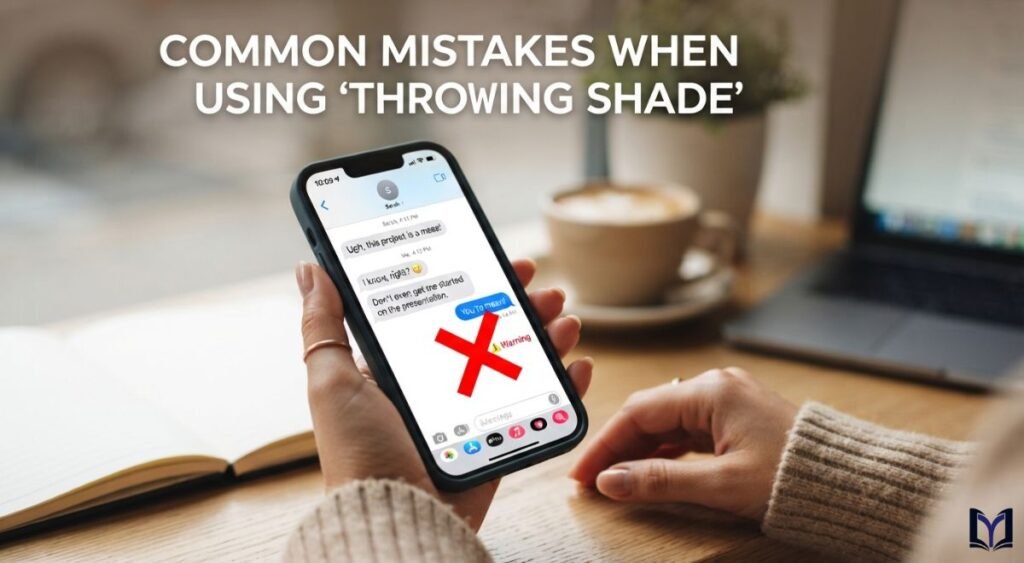
One of the biggest common mistakes is calling every negative statement shade. A person can criticize someone directly without throwing shade. For example, “You missed the deadline” is direct criticism. It doesn’t automatically become shade because the statement is negative. Another mistake involves treating every joke as an insult. Friends often joke with each other without intending disrespect. The situation, relationship, and context and usage determine how the remark works. Another common error is assuming that a compliment can never contain shade. A backhanded compliment can sometimes carry implied criticism beneath positive words.
Grammar also matters. “She threw shade” refers to the past. “She is throwing shade” describes an action happening now. “He likes to throw shade” describes a general habit. Using these forms correctly creates natural sentence examples and improves your correct usage. Another mistake is forcing the expression into formal writing. If a report needs to describe an indirect insult, “indirect criticism” is usually clearer. The best incorrect usage to avoid is any sentence where the phrase describes an openly stated attack. Shade depends on subtlety. Remove the subtlety, and the expression may no longer fit.
| Common Mistake | Better Usage | Reason |
| Calling every insult shade | Use “direct insult” for open attacks | Shade is usually indirect |
| Calling every joke shade | Check the target and tone | Jokes aren’t always criticism |
| Using it in formal reports | Use “indirect criticism” | The slang can sound too casual |
| Ignoring context | Consider the full conversation | Meaning depends on context |
| Repeating the phrase too often | Use natural variations | Overuse sounds forced |
Conclusion
The simplest throwing shade meaning is indirectly criticizing, insulting, mocking, or disrespecting someone. The phrase can describe a clever joke, a pointed caption, a sarcastic response, or a subtle remark. Its defining feature is the indirect delivery. When someone throws shade, they often avoid saying the criticism in the most direct way. Instead, they rely on subtle language, humor, sarcasm, word choice, or shared context. That is why understanding the situation matters as much as understanding the words.
Today, you may encounter throwing shade in text, throwing shade on social media, or throwing shade in conversation. The phrase works naturally in casual settings. It can describe playful teasing among friends or sharper criticism during an argument. Its history also connects to African American culture, LGBTQ+ communities, and New York ballroom culture before the expression entered broader mainstream language. Once you understand the difference between a subtle insult, a direct attack, playful teasing, and genuine criticism, the throwing shade definition becomes much easier to recognize and use correctly.
FAQ’s About Throw Shade Meaning
What does throw shade meaning?
“Throw shade” means to make a subtle or indirect insult, criticism, or sarcastic comment about someone.
What does “throw shade” mean in slang?
In slang, “throw shade” means indirectly criticizing or disrespecting someone, often with humor or sarcasm.
What does it mean if you throw shade?
If you throw shade, you’re making a pointed comment about someone without openly attacking them.
How do you throw shade at someone?
You throw shade by using a sarcastic, clever, or indirect remark that hints at someone’s flaws or behavior.
What does it mean when someone throws you shade?
It means someone is indirectly criticizing, mocking, or disrespecting you through a comment, joke, or subtle remark.
Related Articles: Bts Meaning Slang: What Does BTS Mean in Chat & Social Media?

Welcome to Meanings There! I’m the creator and author behind this website, sharing useful meanings, explanations, and informative content to make words and phrases easier to understand.
1 thought on “Throw Shade Meaning: What Does “Throwing Shade” Mean?”