

If you’ve ever received “STSU” in a text, you might have paused and wondered what those four letters mean. The stsu meaning can feel confusing because this abbreviation isn’t as common as LOL or BRB. In most online conversations, STSU refers to “Shut The Stuff Up,” a softer or censored way to tell someone to stop talking. However, the intended message can change with the context and tone of the conversation.
Friends may use it jokingly, while strangers could see it as rude or disrespectful. You may also find STSU in texting slang, social media comments, and online chats. Learning its meaning helps you understand digital conversations more clearly.
What Does STSU Mean in Text?
The most common STSU meaning in text is “Shut The Stuff Up.” In many cases, people use it as a censored or softened version of a stronger expression that tells someone to stop talking. It belongs to texting slang, internet slang, and online slang rather than standard English. Unlike highly established text abbreviations, STSU has limited and inconsistent usage, so you shouldn’t assume that every person means exactly the same thing. Several current slang references describe the expression as a playful, sarcastic, or sometimes rude reaction depending on context.
So, if you’re asking what does STSU mean in text, the safest answer is: it usually tells someone to be quiet or expresses disbelief in a blunt, slangy way. The STSU full form is commonly given as “Shut The Stuff Up,” while some users treat it as a censored variation of “Shut The ___ Up.” That distinction matters because the expression still carries the force of telling someone to stop talking. In a friendly conversation, it can mean something closer to “No way!” or “You’re kidding!” However, without a friendly tone, it can easily sound disrespectful.
STSU Meaning at a Glance
| Term | Common meaning | Typical tone | Best setting |
| STSU | Shut The Stuff Up / censored “shut up” expression | Playful to rude | Casual chats |
| STSU slang | A blunt reaction or request for silence | Informal | Friends and online chats |
| STSU abbreviation | Shortened digital expression | Casual | Texting and social media |
| STFU | Stronger “shut up” expression | Harsh | Usually avoid |
One useful fact stands out: STSU doesn’t have the same universal definition as highly established internet abbreviations. Some online pages give conflicting expansions, which is a sign that STSU meaning depends heavily on usage rather than a formal dictionary standard.
What Does STSU Mean in Different Contexts?
The meaning of STSU can shift when the situation changes. In a playful exchange, someone might send “STSU 😂” after a friend makes an outrageous claim. Here, the sender probably isn’t demanding silence. The expression acts more like “Stop, you’re making me laugh,” “You’re kidding,” or “I don’t believe you.” In an argument, however, the same abbreviation can become a direct command. That difference shows why STSU context, STSU tone, and STSU usage matter more than the four letters alone. Current usage guides also describe STSU as capable of expressing surprise, sarcasm, teasing, or irritation.
The easiest way to decode STSU meaning slang is to read the entire exchange instead of isolating the abbreviation. Look at what came immediately before it. Then consider whether the sender normally jokes with you. An emoji can soften the message, while a period or an angry follow-up can make it feel much sharper. For example, “STSU 😂 you actually did that?” sounds dramatically different from “STSU. I’m done talking.” The first likely carries a friendly tone. The second suggests frustration and a desire to end the conversation.
Related Articles: ASL Meaning in Text: What Does ASL Mean in Chat, Snapchat & Social Media?
STSU Meaning Slang by Context
| Context | Example | Likely meaning | Tone |
| Friendly joke | “STSU 😂 you actually said that?” | You’re kidding | Playful |
| Surprise | “STSU, no way!” | I can’t believe it | Excited |
| Teasing | “Bro STSU 😭” | Stop joking around | Humorous |
| Argument | “STSU. I’m done.” | Stop talking | Rude |
| Online reaction | “STSU 💀” | That’s unbelievable | Dramatic |
Where Is STSU Commonly Used?
You’ll mainly encounter STSU in text messages, private chats, online chats, and other spaces where people use informal language. It can appear in casual conversations, group chats, gaming chats, comment sections, and private messages. These environments move quickly, which encourages short forms, acronyms, and other chat abbreviations. STSU fits that pattern because it compresses a longer expression into four letters. Still, its limited recognition means it isn’t as dependable as familiar internet abbreviations such as LOL or IDK.
You’ll also see STSU in social media spaces where users rely on fast reactions. Social media comments, gaming communities, and Discord chats can encourage dramatic shorthand because users often respond in seconds. Even there, audience matters. A close friend may understand the joke immediately. A stranger might read it literally and assume you’re being hostile. That’s why STSU in digital communication works best when both people already understand each other’s communication style.
STSU in Casual Online Communication
STSU works most naturally when the audience already understands casual digital language. If a friend regularly uses slang, emojis, memes, and playful reactions, the abbreviation may feel normal. If you’re speaking with someone unfamiliar with modern texting culture, clarity becomes more important. In that situation, writing the full thought usually beats making the reader decode an obscure abbreviation.
STSU Meaning on Snapchat, Instagram, TikTok, and WhatsApp
The STSU meaning on social media generally stays close to its common texting sense, yet the surrounding culture can influence how it feels. STSU on Snapchat may appear in private snaps or quick friend-to-friend messages. STSU on Instagram can show up in Instagram DMs, replies, or reaction comments. STSU on TikTok may appear in TikTok comments when someone reacts dramatically to a surprising video or statement. STSU on WhatsApp is more likely to appear in private conversations or WhatsApp chats, where relationships and existing inside jokes often shape the meaning.
The platform doesn’t automatically create a new definition. Instead, each platform provides a different setting for the same slang. Snapchat tends to support quick personal exchanges. TikTok encourages short public reactions. Instagram blends comments with private messaging. WhatsApp often supports longer personal conversations and group discussions. Across all four, the same rule applies: check the audience, surrounding words, emojis, and social context before deciding what STSU means. Current online examples consistently emphasize this context-driven interpretation.
Does STSU Mean the Same on Every Platform?
Generally, yes. The core expression remains similar across platforms, but the emotional tone can change. A laughing emoji may signal playful teasing. A blunt message without context may sound aggressive. That flexibility explains why people sometimes disagree about STSU meaning online even after reading the same abbreviation.
Is STSU Rude, Offensive, or Informal?
If you’re wondering is STSU rude, the honest answer is: it can be. STSU carries a “shut up” style meaning, which naturally has a sharper edge than neutral expressions. Between close friends, the phrase may work as exaggerated humor. Between strangers, coworkers, teachers, or people in a serious discussion, it can sound dismissive. In other words, STSU isn’t automatically offensive every time someone types it. However, it carries enough verbal force that you should treat it as rude or offensive unless the relationship clearly supports playful use.
Another important point is that written language removes many clues you normally get from speech. When someone says “shut up” while laughing, you can hear the joke. A text message can’t provide that same vocal signal. Emojis can help, yet they don’t guarantee that the recipient will interpret the message correctly. For that reason, STSU belongs firmly to informal language, not formal communication or professional communication. If respect and clarity matter, choose a clearer expression.
When Can STSU Sound Offensive?
STSU becomes risky when the recipient doesn’t know you’re joking. It can also feel harsh during an argument, when someone is discussing a serious problem, or when a power difference exists between the speakers. If the message could reasonably be read as an order to stop speaking, another phrase will usually communicate your point more safely.
Real-Life Examples of STSU in Text Conversations
The best way to understand STSU in text messages is to see how the same expression behaves in different situations. Imagine a friend says, “I just met my favorite actor at the grocery store.” A playful response might be “STSU 😂 no way!” Here, STSU doesn’t necessarily mean “be quiet.” It expresses disbelief and excitement. The same abbreviation can appear in real-life examples involving teasing, gossip, gaming, jokes, or arguments. The surrounding words provide the missing emotional information.
Consider another situation. Someone says, “You’re wrong about everything.” If the reply is “STSU. I’m not arguing anymore,” the message feels much more hostile. That example shows why texting examples should always include context. The abbreviation alone doesn’t tell you whether the sender is joking. The relationship, punctuation, previous messages, and intent all help reveal the meaning.
STSU Examples in Text Messages
| Situation | Text example | Likely interpretation |
| Surprise | “STSU 😂 you met him?” | No way, really? |
| Teasing | “STSU bro, you lost again 😭” | Stop joking |
| Gossip | “STSU, tell me everything!” | Dramatic excitement |
| Gaming | “STSU 😂 that was lucky!” | Playful reaction |
| Argument | “STSU. I’m finished explaining.” | Stop talking |
| Confusion | “STSU? What do you mean?” | Asking for clarification |
These examples also reveal an important pattern. STSU often works as a reaction rather than a literal command. In friendly conversations, users may use it to amplify surprise. In tense conversations, the literal “stop talking” meaning becomes stronger. That difference makes STSU tone one of the most important parts of understanding the slang.
Related Articles: ASL Meaning in Text: What Does ASL Mean in Chat, Snapchat & Social Media?
When Should You Use or Avoid STSU?
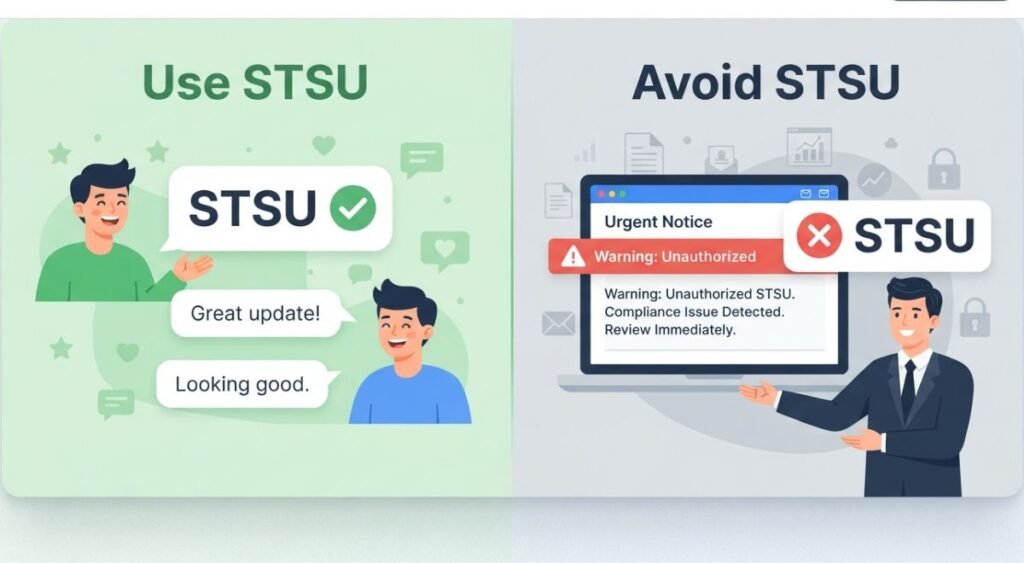
You should generally use STSU only when you’re confident that the recipient understands your style of humor. A close friend who regularly uses internet slang may understand “STSU 😂” instantly. Someone you barely know may not. When you’re unsure, choose plain language. Clear communication is rarely a bad choice, while an ambiguous abbreviation can turn a harmless joke into an awkward exchange. That’s especially true when you’re deciding when to use STSU in a new relationship or online community.
You should know when not to use STSU, too. Avoid it in job applications, workplace emails, academic writing, customer-service messages, and formal requests. It can also be a poor choice during emotional conversations. Even if you intend humor, the recipient may hear disrespect instead. In professional settings, expressions such as “Could you please stop?” or “Let’s stay focused” communicate the idea without the unnecessary edge.
Is STSU Appropriate at Work?
STSU isn’t a good choice for most workplace communication. Professional communication depends on clarity, respect, and predictable meaning. Since STSU can carry implied profanity or hostility, it may create the wrong impression. Use direct wording instead, especially when speaking with managers, clients, customers, or people outside your immediate team.
| Situation | STSU appropriate? | Better approach |
| Close friend | Usually, if playful | STSU 😂 |
| Gaming friend | Sometimes | Match the group tone |
| Stranger | Risky | Use clear language |
| Coworker | Usually avoid | “Let’s pause here.” |
| Manager | Avoid | “Could we stay focused?” |
| Customer | Avoid | Use polite wording |
How to Respond When Someone Says STSU
Your STSU response should depend on the sender’s intent. If a close friend sends “STSU 😂,” you can usually answer with the same playful energy. A simple “You wish 😂” or “I’m serious!” keeps the exchange moving. If the sender sounds annoyed, don’t automatically joke back. You might ask what caused the frustration or calmly explain your point. When the meaning isn’t obvious, the best how to respond to STSU strategy is surprisingly simple: ask.
A clarification question can prevent a small misunderstanding from becoming a bigger problem. You can write, “What do you mean by STSU?” if the abbreviation doesn’t make sense. If the message seems hostile, you can say, “No need to be rude” or “Let’s talk calmly.” Don’t feel pressured to match an aggressive tone. Good communication clarity matters more than winning a slang exchange.
What Should You Say if STSU Is Used Rudely?
If someone uses STSU aggressively, keep your reply calm and direct. You might say, “I’m happy to discuss it, but please keep it respectful.” If the conversation is already heated, stepping away can be wiser than trading insults. A short, measured reply often does more than another sharp abbreviation.
| Situation | Suggested response | Purpose |
| Playful | “😂 You wish!” | Match the joke |
| Surprising | “Wait, seriously?” | Continue the reaction |
| Unclear | “What does STSU mean here?” | Clarify |
| Annoyed sender | “What’s wrong?” | Understand the issue |
| Rude message | “Let’s keep it respectful.” | Set a boundary |
Similar Slang Words and Polite Alternatives to STSU
There are plenty of STSU alternatives when you want the same general reaction without sounding harsh. “Seriously?” can express disbelief. “You’re kidding!” works well when something sounds unbelievable. “Come on!” can show playful frustration. “Give me a break!” adds a stronger reaction while avoiding the direct command implied by STSU. These polite alternatives are especially useful when you aren’t sure how the other person will interpret your message.
STSU also differs from other slang terms because its meaning centers on telling someone to stop talking or reacting strongly to what they said. For example, LOL signals laughter. OMG signals surprise. IDK signals uncertainty. STFU is much stronger and more explicitly profane. Understanding these differences helps you choose the right expression instead of throwing slang into a message simply because it looks familiar.
STSU vs. Similar Texting Abbreviations
| Expression | Meaning | Tone | Typical use |
| STSU | Shut The Stuff Up / censored “shut up” | Playful to harsh | Casual reactions |
| STFU | Shut The F*** Up | Strong and offensive | Usually avoid |
| LOL | Laughing Out Loud | Friendly | Humor |
| OMG | Oh My God | Surprised | Reactions |
| IDK | I Don’t Know | Neutral | Uncertainty |
| SMH | Shaking My Head | Disappointed or amused | Reactions |
The key difference is simple: STSU can directly target another person’s speech. That makes it more sensitive than many ordinary chat abbreviations. If your goal is only to show surprise, an alternative may communicate your emotion without creating unnecessary tension.
Common Misunderstandings About STSU
One of the biggest common misunderstandings about STSU is assuming that it always means genuine anger. That’s not necessarily true. Friends can use it playfully. Someone may type “STSU 😂” after hearing an unbelievable story, even though they aren’t actually angry. Another misunderstanding happens when people assume STSU has one official expansion. Current online sources disagree about secondary interpretations, which shows that the abbreviation isn’t fully standardized.
Another mistake involves confusing STSU with STFU. The two look similar, yet STFU is a more established and considerably stronger profanity-based expression. Some users may also interpret STSU as a private abbreviation or a typo. If the surrounding message doesn’t make the meaning clear, don’t guess with complete confidence. Read the full conversation, consider the sender, and look for clues in the social context. That approach works for STSU and almost every other piece of modern slang.
How to Understand STSU From Context
Start by reading the messages immediately before and after STSU. Next, consider your relationship with the sender. Then check emojis, punctuation, capitalization, and the subject being discussed. Finally, ask yourself whether the message sounds like a joke, surprise, teasing, frustration, or a genuine command. This simple process can help you decode unfamiliar slang variations without relying on a single definition.
Conclusion
The most common stsu meaning in current texting usage is “Shut The Stuff Up,” or a censored variation of a stronger “shut up” expression. People may use it literally to tell someone to stop talking. They may also use it playfully to express disbelief, surprise, teasing, or dramatic excitement. The meaning isn’t completely standardized, so STSU context remains essential. Current online references consistently describe it as informal slang whose tone can range from humorous to rude.
If you see STSU in a message, don’t judge the meaning from the letters alone. Look at the relationship, surrounding words, emojis, and emotional tone. Use it carefully with close friends, and avoid it in professional or serious settings. When you’re unsure, ask what the sender means. In modern slang, clarity still wins the race. Understanding that simple rule will help you handle STSU and other evolving text abbreviations with much more confidence.
FAQ’s About Stsu Meaning
What does STSU mean?
STSU commonly means “Shut The Stuff Up,” a softer or censored way of telling someone to stop talking. Its tone can be playful or rude depending on context.
What does STSU mean in texting?
In texting, STSU usually means “Shut The Stuff Up.” Friends may use it jokingly, while others may use it to show annoyance.
What does STHU mean in text?
STHU usually means “Shut The Hell Up” or a similar “shut up” phrase. It can sound rude or offensive, especially in serious conversations.
What does STS mean in text slang?
STS can have different meanings depending on context, such as “Same Thing, Same” or a community-specific abbreviation. The surrounding message helps identify the intended meaning.
What does SWU mean in texting?
SWU can mean different things in texting because it isn’t a widely standardized abbreviation. Its exact meaning depends on the conversation and the community using it.
Related Articles: ASL Meaning in Text: What Does ASL Mean in Chat, Snapchat & Social Media?

Welcome to Meanings There! I’m the creator and author behind this website, sharing useful meanings, explanations, and informative content to make words and phrases easier to understand.