

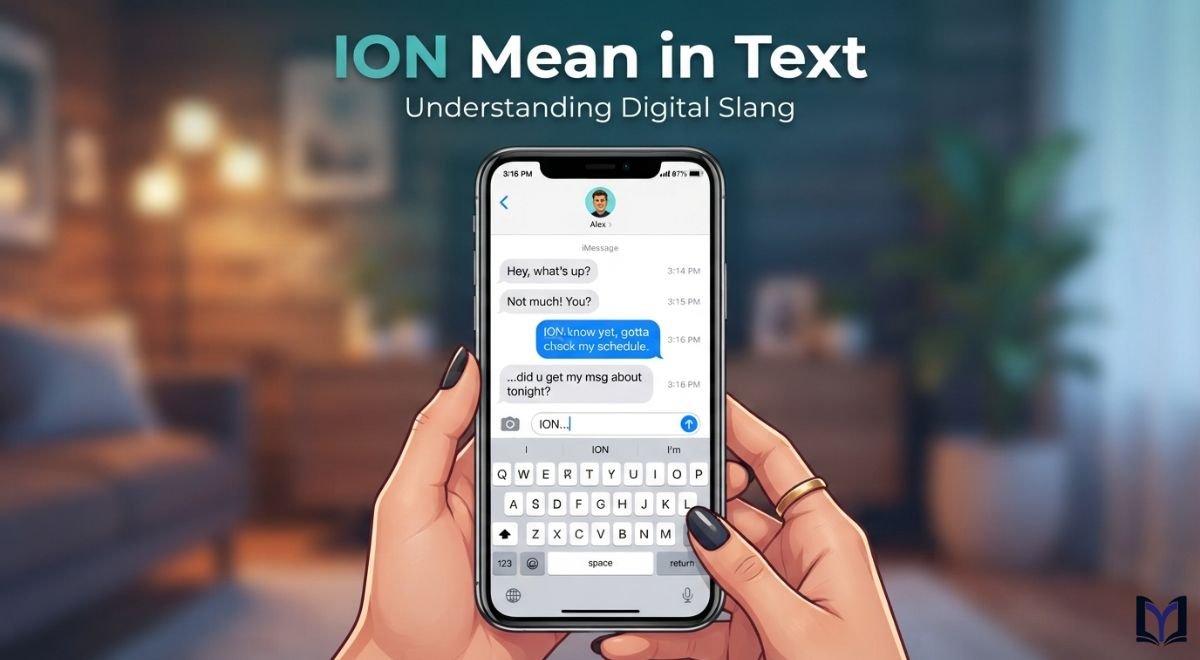
Wondering what does ION mean in text? You’re not alone. This short term appears frequently in text messages, social media comments, DMs, and casual online conversations. In most modern slang usage, “ION” means “I don’t,” especially in phrases like “ion know” or “ion care.” However, the exact ion meaning can change depending on the sentence and context.
Sometimes, “ION” can also mean “In Other News,” while the lowercase word “ion” has a completely different meaning in chemistry. Understanding the context helps you avoid confusion. In this guide, you’ll learn the ion slang meaning, common examples, social media usage, and how to respond naturally when someone uses it.
What Does ION Mean in Text?
The most common ion meaning in text is “I don’t.” People use “ion” as a casual shortened form when they want their messages to sound natural, quick, and conversational. For example, “ion know” usually means “I don’t know.” Likewise, “ion care” means “I don’t care.” This style reflects spoken language more than traditional written English. You’ll mainly find it in casual conversation, especially among people who already understand internet slang. If someone writes, “ion think that’s right,” the intended meaning is usually “I don’t think that’s right.”
The term can look strange when you first encounter it. That happens because standard English doesn’t normally use “ion” this way. In slang in text messages, however, people often reshape words to match how they sound when spoken quickly. The result is a distinctive typing shortcut that saves characters while preserving the speaker’s meaning. Therefore, the best answer to what does ion mean depends on the sentence around it. When “ion” comes before a verb such as “know,” “care,” “want,” or “think,” it usually points to “I don’t.”
What Does “ION” Stand For?
In its common slang use, ion and I don’t represent the same idea. It isn’t a strict acronym where each letter represents a separate word. Instead, it works more like a conversational contraction or phonetic shortcut. The spelling reflects a casual pronunciation pattern rather than formal spelling rules.
| Texting phrase | Standard English | Likely meaning |
| “ion know” | “I don’t know” | Lack of knowledge |
| “ion care” | “I don’t care” | Lack of concern |
| “ion think so” | “I don’t think so” | Disagreement or uncertainty |
| “ion want it” | “I don’t want it” | Refusal |
| “ion like that” | “I don’t like that” | Negative opinion |
This distinction makes ion definition in text fairly simple. It usually works as slang rather than formal vocabulary.
Related Articles: What Does YWA Mean in Text? Slang, Examples & How to Use It
What Does ION Mean in Texting and Social Media?
The ion meaning in texting becomes especially clear when you look at how people communicate online. You may encounter ion in chat, private messages, captions, replies, and comment sections. The expression fits naturally into informal chats because those spaces allow people to bend spelling and grammar. Someone might type “ion wanna go” instead of “I don’t want to go.” Both communicate the same basic thought. The difference lies in style, not the underlying message.
On platforms such as Snapchat, TikTok, and Instagram, slang spreads quickly through repeated exposure. That makes ion on Snapchat, ion on TikTok, and ion on Instagram common searches for people who encounter the expression for the first time. The ion social media meaning generally remains “I don’t” when the surrounding sentence supports that interpretation. However, platform culture can influence how casual or expressive the word feels. A creator might use it in a funny caption, while a friend might use it during a serious conversation.
ION Meaning on Snapchat, TikTok, and Instagram
On Snapchat chats, “ion” often appears in short messages between friends. TikTok users may use it in TikTok comments or captions because the platform encourages fast, conversational language. Instagram users can also place it in Instagram DMs, replies, and social media comments.
The ion meaning in social media doesn’t usually change from one platform to another. Instead, the surrounding sentence gives you the clue. Consider these examples: “ion even know 😂” means “I don’t even know,” while “ion want to hear that” means “I don’t want to hear that.” The platform changes, but the underlying ion text meaning remains similar.
ION and Modern Gen Z Texting Culture
Modern online communication rewards speed and personality. That environment has helped ion Gen Z slang become recognizable to many younger internet users. It sits alongside familiar terms such as IDK, IDC, NGL, FR, TBH, and RN. These expressions form part of a broader system of modern texting slang where users prioritize tone and speed over formal grammar.
Still, “ion” shouldn’t be treated as something every Gen Z speaker uses. Slang varies by community, region, age, and social group. Online language isn’t one giant dictionary. It’s more like a neighborhood with different accents.
The Most Common Meanings of ION
The strongest ion slang meaning in current casual texting is “I don’t.” You’ll often see it attached to another word rather than standing completely alone. “Ion know” expresses uncertainty. “Ion care” expresses indifference. “Ion want that” communicates refusal. “Ion think so” expresses disagreement or doubt. In each case, the rest of the sentence supplies the missing grammatical structure.
There is another interpretation worth knowing. In some contexts, uppercase “ION” has been used as shorthand for “In Other News.” This usage usually introduces a topic shift, especially when someone moves from one subject to an unrelated update. For example, “ION, did you see the new movie?” can mean “In other news, did you see the new movie?” The chemistry term “ion” creates another possible meaning. Therefore, ION vs ion requires attention to context rather than capitalization alone.
ION = “I Don’t”
When someone writes “ion like it,” the intended sentence is normally “I don’t like it.” The same pattern works with many common verbs.
| ION phrase | Full meaning | Purpose |
| “ion know” | I don’t know | Uncertainty |
| “ion care” | I don’t care | Indifference |
| “ion think so” | I don’t think so | Doubt |
| “ion want that” | I don’t want that | Refusal |
| “ion like him” | I don’t like him | Opinion |
This is why what does “ion” mean in text doesn’t always have a one-word answer. The word acts as a compact opening that combines with what follows.
ION = “In Other News”
The “In Other News” interpretation appears less often in many modern casual chats. It usually works as a transition. Someone may use it after discussing one subject before suddenly introducing another.
For example, imagine two friends discussing an exam. One writes, “That test was brutal. ION, did you see the concert announcement?” Here, “ION” signals a fresh subject. Context makes this meaning clear.
ION as a Scientific Word
In chemistry, an ion is an electrically charged atom or molecule. It becomes charged when it gains or loses electrons. A positively charged ion is called a cation, while a negatively charged ion is called an anion.
That scientific meaning has nothing to do with texting slang. If someone writes, “Sodium forms an ion,” they’re discussing chemistry. If someone writes, “ion know what happened,” they’re almost certainly using internet slang.
How to Understand ION Based on Context
Context acts like a decoder ring for online slang. When you see “ion,” don’t interpret the word in isolation. First, read the entire sentence. Then look at the words before and after it. Context clues can quickly tell you whether the writer means “I don’t,” “In Other News,” or the scientific term. For instance, “ion believe you” clearly resembles “I don’t believe you.” Meanwhile, “ION, speaking of movies…” suggests a topic transition.
The platform also provides useful information. Ion meaning online usually points toward casual internet language when you see it in a meme, comment, DM, or friend’s message. A chemistry textbook gives you a completely different clue. Tone matters too. A message such as “ion care 😭” may sound playful between friends. The same words during an argument could sound cold or dismissive. In other words, meaning and emotional intent don’t always travel together.
A Simple Context Test for ION
You can use a quick three-step test whenever you’re unsure. First, replace “ion” with “I don’t.” If the sentence suddenly makes perfect sense, you’ve probably found the intended meaning. Next, try “In Other News.” If that sounds unnatural, discard that interpretation. Finally, check the subject. If the conversation involves atoms, electricity, or chemistry, the scientific meaning probably applies.
This simple approach works because slang depends heavily on sentence context. You don’t need to memorize every possible internet abbreviation. You only need to examine how the word functions in the conversation.
Is ION Rude, Flirty, or Offensive?
On its own, “ion” isn’t inherently rude, flirty, or offensive. Its emotional effect comes from the surrounding words, relationship, and tone. Between close friends, “ion know 😂” can sound relaxed and harmless. During an argument, “ion care” might feel blunt. The same phrase can therefore carry a completely different emotional weight depending on who sends it.
The expression also isn’t naturally romantic. A flirty tone comes from the complete message rather than the word “ion.” For example, “ion usually text first, but I made an exception for you” can sound playful or flirtatious because of the surrounding idea. The slang itself doesn’t create that meaning. It simply contributes to a casual conversational language style.
When ION Sounds Neutral
In ordinary casual texting, “ion” often sounds relaxed. Friends may use it without intending any hidden message. A phrase such as “ion know yet” usually communicates simple uncertainty.
When ION Can Sound Rude
Short replies can sometimes create a rude tone or dismissive tone. “Ion care” may sound harsher than “I don’t really care” because the shorter version can feel abrupt.
Can ION Be Flirty?
It can appear inside a playful tone or romantic conversation. However, it isn’t a dedicated flirting abbreviation. The surrounding words create the flirty tone, not “ion” itself.
Is ION Offensive?
Generally, the slang expression isn’t offensive by itself. Still, any phrase can become hurtful when someone uses it aggressively. Look at the complete message before judging its intent.
How to Use ION Correctly in Texting
If you’re using “ion,” keep the setting informal. It works best in informal communication where slang already feels normal. Friends, group chats, casual DMs, gaming communities, and social media are common places to encounter it. You can use it when you want your message to sound conversational rather than polished. “Ion think I’m going tonight” sounds like everyday casual speech. “I don’t think I’m going tonight” works in every setting.
Formal situations call for standard English. Professional communication, academic work, applications, business emails, and official messages should normally use “I don’t” instead. This isn’t because slang is bad. It simply means different settings have different language expectations. Academic writing and formal writing usually value clarity and consistency over internet-style shortcuts.
Lowercase Ion Meaning vs. Uppercase ION Meaning
The lowercase ion meaning commonly points toward “I don’t” in modern slang. Meanwhile, the uppercase ION meaning may sometimes signal “In Other News.” Capitalization can provide a clue, though it isn’t a guaranteed rule.
| Form | Common interpretation | Typical setting |
| ion | “I don’t” | Casual texting |
| ION | “In Other News” | Topic transitions |
| ion | Charged atom or molecule | Scientific context |
So, when considering ION vs I don’t, remember that “ion” is a casual slang form rather than a replacement for standard English in every situation.
ION Meaning in Real Text Conversations: Examples
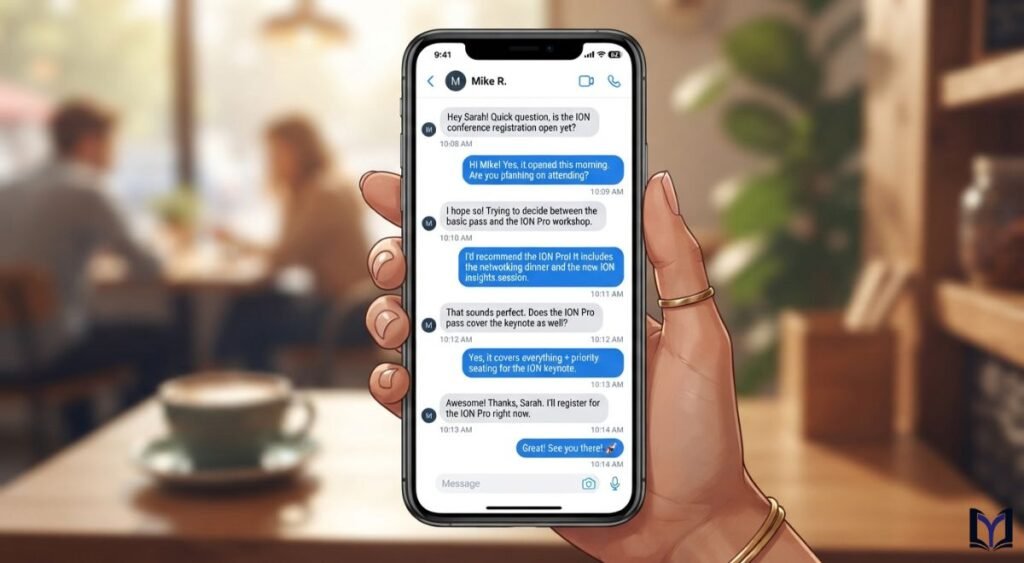
Real messages make slang much easier to understand. Instead of memorizing a definition, imagine how people actually talk in texting culture. Friends rarely write every message like an essay. They shorten words, remove punctuation, add emojis, and imitate speech. That’s exactly where real-life examples become useful.
The examples below show different emotions and situations. Notice how the phrase after “ion” changes the meaning of the complete message. The expression can communicate disagreement, denial, uncertainty, an opinion, or a simple refusal. The basic pattern remains casual.
ION Meaning in Everyday Chats
| Conversation | Message | Meaning | Tone |
| Friend asks about dinner | “ion feel like pizza” | I don’t feel like pizza | Casual |
| Friend asks for an opinion | “ion think it’s worth it” | I don’t think it’s worth it | Neutral |
| Friend asks if you remember | “ion remember that” | I don’t remember that | Casual |
| Someone asks if you care | “ion care anymore” | I don’t care anymore | Blunt |
| Friend suggests a plan | “ion wanna go tonight” | I don’t want to go tonight | Honest |
| Someone makes a strange claim | “ion believe you 😂” | I don’t believe you | Playful |
| Friend asks what happened | “ion know bro” | I don’t know, bro | Relaxed |
| Someone asks about a person | “ion like him” | I don’t like him | Direct |
| Friend asks about homework | “ion understand this” | I don’t understand this | Casual |
| Someone asks about tomorrow | “ion know yet” | I don’t know yet | Uncertain |
ION in Dating Conversations
On dating apps, slang can make messages feel less formal. A person might write, “ion usually text first” to explain a personal habit. Another might say, “ion know what I’m looking for yet” while expressing uncertainty.
The key is not to assign a romantic meaning automatically. The ion meaning in conversation stays tied to the sentence. Romance comes from the wider exchange.
ION in Gaming Chats
Fast-paced gaming chats also favor shortened language. A player might type “ion see them” while communicating quickly during a match. Another might write “ion got ammo” when coordinating with teammates.
Here, speed matters. A typing shortcut can save time when every second counts.
ION in Social Media Comments
In online conversations, people often use slang to make comments feel spontaneous. A TikTok user might write “ion even know what I just watched 😭.” The writer isn’t following formal grammar. They’re reproducing a casual speaking style.
That’s one reason social media slang spreads so quickly. Users see a phrase repeatedly, understand it from context, and begin using it themselves.
ION vs. Similar Texting Slang and Common Confusions
Slang becomes confusing when several short expressions appear together. ION vs I don’t is the most basic comparison because one is casual slang while the other follows standard English. However, readers also confuse “ion” with IDK or IDC because those expressions can appear in similar sentences. The difference becomes obvious when you expand each abbreviation.
Related Articles: What Does YWA Mean in Text? Slang, Examples & How to Use It
For example, IDK means “I don’t know,” while IDC means “I don’t care.” “Ion” can introduce either phrase when followed by the relevant words. Therefore, “ion know” and “IDK” can express similar ideas, but “ion” by itself doesn’t automatically mean “I don’t know.”
Common Texting Terms Compared
| Slang | Meaning | Example |
| ION | I don’t / sometimes In Other News | “ion think so” |
| IDK | I don’t know | “IDK what happened” |
| IDC | I don’t care | “IDC anymore” |
| NGL | Not gonna lie | “NGL, that was funny” |
| FR | For real | “FR, that movie was good” |
| TBH | To be honest | “TBH, I agree” |
| RN | Right now | “I’m busy rn” |
| LMK | Let me know | “LMK when you arrive” |
ION vs. “I’m On”
One common misunderstanding involves reading “ion” as “I’m on.” In modern slang, that’s generally not the intended meaning. If someone writes “ion know,” the sentence strongly supports “I don’t know.” Context removes the ambiguity.
ION vs. the Scientific Term
The scientific word follows completely different rules. In chemistry, an ion carries an electrical charge. In texting, “ion” usually functions as a casual abbreviation or slang form. The surrounding subject tells you which meaning applies.
How to Respond When Someone Says ION
Knowing how to respond becomes easier once you understand the sentence. If someone writes “ion know,” you can simply continue the conversation or ask a follow-up question. There’s no special response required. Treat it like any other casual statement.
If someone says “ion care,” however, pay attention to the tone. A playful conversation might need a playful reply. A serious argument may require a calm response. Don’t assume that short slang automatically signals disrespect. Read the whole exchange first.
Natural Responses to ION
| Message | Possible response | Situation |
| “ion know” | “No worries. I’ll check.” | Neutral |
| “ion care 😂” | “You definitely care.” | Playful |
| “ion think so” | “Fair enough.” | Calm |
| “ion wanna go” | “That’s okay.” | Respectful |
| “ion understand” | “Want me to explain?” | Helpful |
Sometimes the best response is simply to continue normally. If the meaning isn’t clear, ask what the person means rather than guessing.
Common Mistakes People Make When Using ION
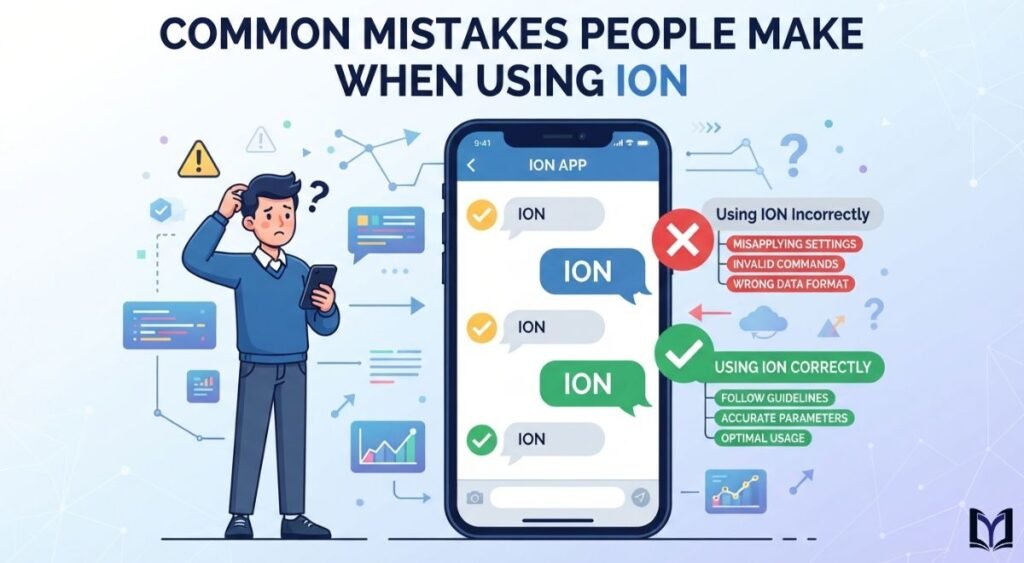
The biggest mistake involves assuming that ion meaning slang has only one possible interpretation. Modern internet language changes with context. A casual TikTok comment may use “ion” differently from a science discussion. Another mistake involves treating slang as a spelling error. Although “ion” may look like a typo to unfamiliar readers, the writer may have chosen it intentionally.
Another issue is using casual slang in the wrong environment. Writing “ion have the file” in a formal business email can make the message look careless. The same sentence works naturally in a friend’s chat. Appropriate usage depends on audience, purpose, and setting. Good communication isn’t about using slang everywhere. It’s about knowing when slang fits.
Common ION Mistakes at a Glance
| Mistake | Why it causes confusion | Better approach |
| Assuming “ion” always means “I don’t” | Context can change meaning | Read the full sentence |
| Assuming it always means “In Other News” | This interpretation may not fit modern slang | Check surrounding words |
| Calling every use a spelling mistake | It can be intentional slang | Consider the conversation |
| Using it in formal writing | It may sound too casual | Use “I don’t” |
| Ignoring the speaker’s tone | Short messages can sound blunt | Read the complete exchange |
| Confusing it with “I’m on” | The sentence usually doesn’t support that meaning | Use context clues |
Conclusion
The simplest answer to what does ion mean in text is “I don’t.” In casual online language, people use “ion” as a shortened, conversational form of the phrase. You may encounter it in text messages, DMs, comments, captions, gaming chats, and other informal spaces. The ion meaning in text can still depend on context. In some situations, “ION” may mean “In Other News,” while a chemistry discussion uses “ion” in its scientific sense.
Ultimately, context is your best guide. Look at the words around “ion,” consider the platform, and pay attention to the speaker’s tone. Once you understand those clues, this piece of internet slang becomes much less mysterious. Use it freely in relaxed conversations if it matches your style. For professional or academic situations, stick with standard English such as “I don’t.”
FAQ’s About Ion Meaning In Text
What does ION mean in text?
In text, ION usually means “I don’t.” For example, “ion know” means “I don’t know.”
What does it mean when a girl says “ion”?
When a girl says “ion,” she usually means “I don’t,” depending on the sentence and context. It’s generally casual texting slang.
What does “ions” mean in slang?
“Ions” can be a variation or typo of “ion,” which commonly means “I don’t” in casual slang. Its meaning depends on the conversation.
What does ion mean in texting?
In texting, ion is a shortened form of “I don’t,” often used in phrases like “ion care,” “ion know,” or “ion want.”
What does “Gen Z” mean in slang?
Gen Z refers to Generation Z, the generation commonly associated with modern internet culture, social media, and evolving online slang.
Related Articles: What Does YWA Mean in Text? Slang, Examples & How to Use It

Welcome to Meanings There! I’m the creator and author behind this website, sharing useful meanings, explanations, and informative content to make words and phrases easier to understand.
1 thought on “ION Mean in Text? Meaning, Slang, Contexts, Example & Usage”