

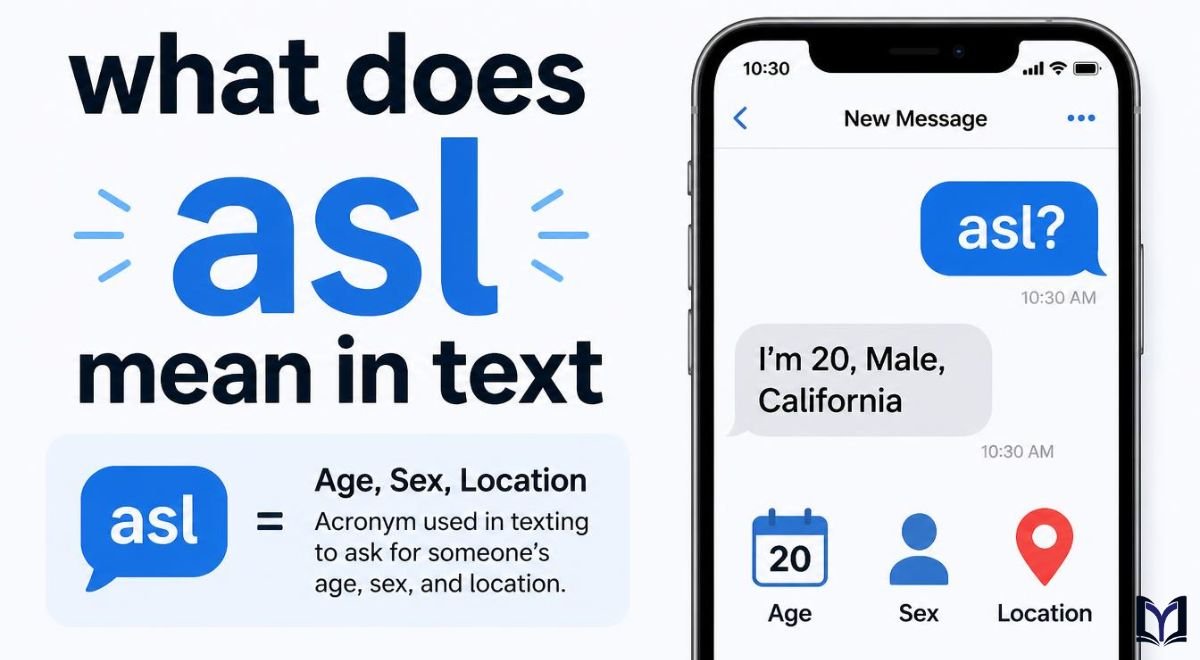
Ever received “ASL?” in a message and wondered what those three letters mean? If you’re searching what does asl mean in text, the answer depends on the conversation. Traditionally, ASL means “Age, Sex, Location,” an old ASL abbreviation once common in online chat rooms. Today, though, “asl” often appears as ASL slang meaning “as hell,” especially on social media.
It can also mean American Sign Language when people discuss communication, education, or accessibility. You may even find ASL in medical, scientific, or aviation contexts. This guide explains the most common meanings, real text examples, social-media uses, dating context, and simple ways to understand ASL without guessing.
What Does ASL Mean in Text?
The most traditional ASL meaning in text is Age, Sex, Location. People used this short question in online chat, especially when meeting someone new. “ASL?” could quickly ask about your age, sex, and location without typing a full sentence. For example, a person might write, “Hey, ASL?” A traditional ASL response could be “24, male, Dallas.” However, modern users may use ASL differently. In ASL in texting, the lowercase form often appears after an adjective. A message such as “That game was fun asl” usually means “That game was fun as hell.” Therefore, what does asl mean cannot always be answered with one definition. The words around it usually reveal the intended meaning.
Another common ASL definition is American Sign Language. In this sense, ASL describes a complete visual language used by many Deaf people in the United States and some parts of Canada. You might see it in phrases such as “ASL class,” “ASL interpreter,” or “I’m learning ASL.” That meaning differs completely from the old chat question. There is also a technical meaning in medical imaging called arterial spin labeling. Aviation and geographic writing can use ASL to mean above sea level. This makes ASL a versatile ASL acronym rather than a slang term with one fixed meaning. When you see ASL in ASL in text messages, first consider the topic before choosing a definition.
What Does ASL Stand For in Chat & Texting?
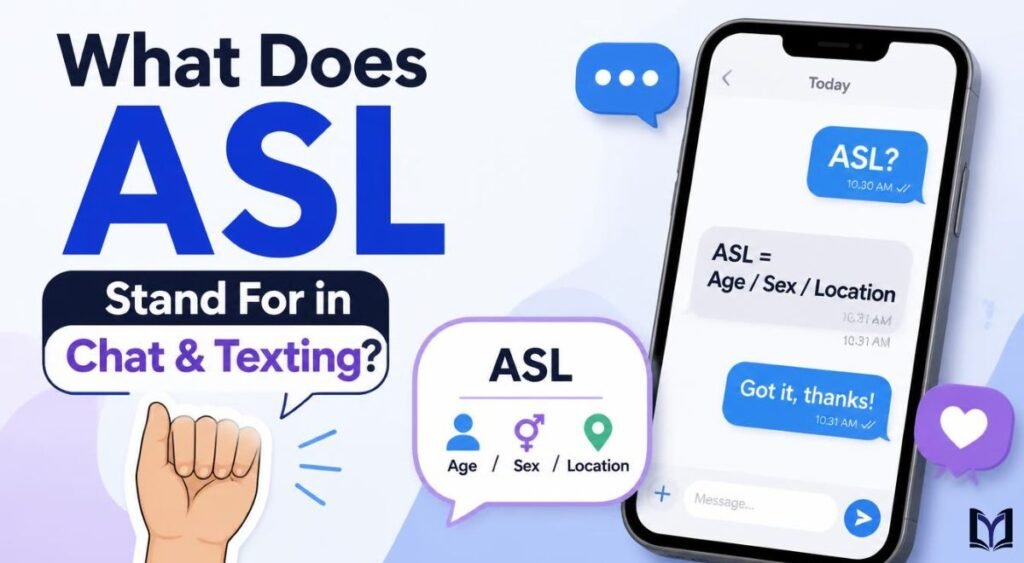
In older ASL in chat conversations, ASL stands for Age, Sex, Location. The abbreviation became popular because early internet users often wanted a quick way to introduce themselves. Instead of typing three separate questions, they could simply ask “ASL?” The first letter referred to age, the second to sex, and the third to location. This became a recognizable ASL chat abbreviation in early online communities. People commonly used it in chat rooms and instant messaging. The phrase was especially useful when users were talking with people they had never met. For many years, “ASL?” was almost a shorthand handshake in online introductions.
The traditional question sounds simple, but its meaning has changed with online culture. Today, many people share their age and general location on profiles. Dating platforms also provide more information before a conversation begins. As a result, traditional ASL meaning may sound old-fashioned to some users. It can still appear in casual chats, role-playing spaces, nostalgic conversations, or messages between people familiar with older internet culture. It may also appear as a joke about the early internet. For example, someone might jokingly write, “Welcome to the old internet. ASL?” The intended meaning remains Age, Sex, Location, but the tone can be playful rather than serious.
Related Articles: MD Meaning in Text: What Does MD Mean in Chat & Social Media?
How Is ASL Used on Social Media?
The ASL meaning in social media often differs from its older chat meaning. One of the most common modern uses is “as hell.” In this form, ASL slang usually appears after an adjective or description. A person might write, “I’m tired asl,” which means “I’m extremely tired.” Another person might comment, “That puppy is cute asl.” Here, the abbreviation acts as an informal intensifier. It strengthens the word before it. This version of ASL in internet slang appears in comments, captions, messages, and casual posts. It has become part of the fast-moving style of social media writing, where users often shorten familiar phrases.
The exact tone still depends on the conversation. “That test was hard asl” sounds casual and expressive. It would feel out of place in a formal report or professional email. The same applies to school assignments, job applications, and business documents. ASL social media slang belongs mainly to relaxed communication. Capitalization can offer a clue, too. Capitalization may make “ASL” look like a formal abbreviation, while “asl” often appears as slang. However, this isn’t a strict rule. People type quickly, and many users ignore capitalization entirely. Therefore, the position of ASL in the sentence matters more than its letter case alone.
What Does ASL Mean on Snapchat, TikTok, Instagram & Dating Apps?
The ASL meaning on Snapchat can change according to the message. If someone sends only “ASL?” during a private conversation, they may be using the traditional Age, Sex, Location meaning. If someone writes “That filter is funny asl,” the same letters mean “as hell.” The ASL meaning on TikTok often appears in the second form because short slang expressions fit naturally into comments and captions. The ASL meaning on Instagram works in much the same way. Users may place “asl” after words such as cute, funny, tired, busy, or crazy. On WhatsApp, both forms can appear because private chats often mix older abbreviations with newer slang. Therefore, the ASL meaning on WhatsApp depends strongly on the sentence.
Dating creates another important use. The ASL dating meaning traditionally relates to asking someone’s age, sex, and location. Someone may still type “ASL?” when starting a conversation with a stranger. However, ASL meaning in dating apps can feel dated because modern profiles often show age and general location already. A person may use the phrase jokingly or as a quick way to learn basic details. ASL online dating also raises a privacy issue. You don’t need to share your exact address, workplace, school, or live location with someone you don’t know. A city or broad region gives less identifying information. When an online conversation moves too quickly toward private details, slow down and decide what you actually want to reveal.
| Platform or setting | Common ASL meaning | Example |
| Snapchat | Age, Sex, Location / as hell | “ASL?” |
| TikTok | As hell | “Funny asl” |
| As hell / American Sign Language | “Cute asl” | |
| Context-dependent | “ASL?” | |
| Dating apps | Age, Sex, Location | “Hey, ASL?” |
| Education | American Sign Language | “I’m taking an ASL class.” |
Is ASL Used to Ask About Age, Sex, and Location?
Yes, ASL can still mean Age, Sex, Location, especially when someone writes “ASL?” as a complete question. The old abbreviation asks for three types of information: your age, your sex, and your location. In modern conversations, some people may interpret “sex” more broadly as a question about gender or identity. The original phrase came from an era when online users had fewer profile details. Asking ASL helped strangers quickly learn basic information about each other. Today, someone might simply ask, “How old are you?” or “Where are you from?” Those direct questions are easier to understand and avoid some of the ambiguity surrounding the old ASL question.
There is also an important privacy concern. You never have to answer an ASL question simply because someone asked. ASL personal information can include details that become sensitive when combined. Giving your exact address, workplace, school, daily routine, or live location can reveal more than you intended. A safer answer might give only your age range and city. You can also say, “I don’t share personal details online.” If the meaning isn’t clear, ask what the person means. In modern online conversations, a little caution can prevent a lot of trouble. The key is to stay in control of your information rather than treating an old abbreviation as an obligation to answer.
How to Respond When Someone Says “ASL?”
Knowing how to respond to ASL starts with identifying what the sender means. If “ASL?” clearly means Age, Sex, Location, you can answer as much as you feel comfortable sharing. For example, you could say, “I’m 25 and based in California.” You don’t need to provide an exact address. If you aren’t comfortable answering, a simple “I’d rather not share that” works perfectly. You can also ask, “What do you mean by ASL?” That response works especially well when the conversation doesn’t provide enough clues. A good ASL response should match both the meaning and the level of trust between the people talking.
When ASL means “as hell”, you normally don’t need to address the abbreviation directly. If someone says, “That concert was amazing asl,” you could reply, “Seriously, it was incredible!” If ASL means American Sign Language, your answer should match that topic instead. For example, someone asking whether you know ASL may be asking about your ability to communicate through sign language. The important point is simple: don’t assume that every “ASL?” has the same meaning. Read the sentence, consider the topic, and then choose your response. That small pause can save you from an awkward misunderstanding.
ASL Examples in Text Messages and Online Conversations
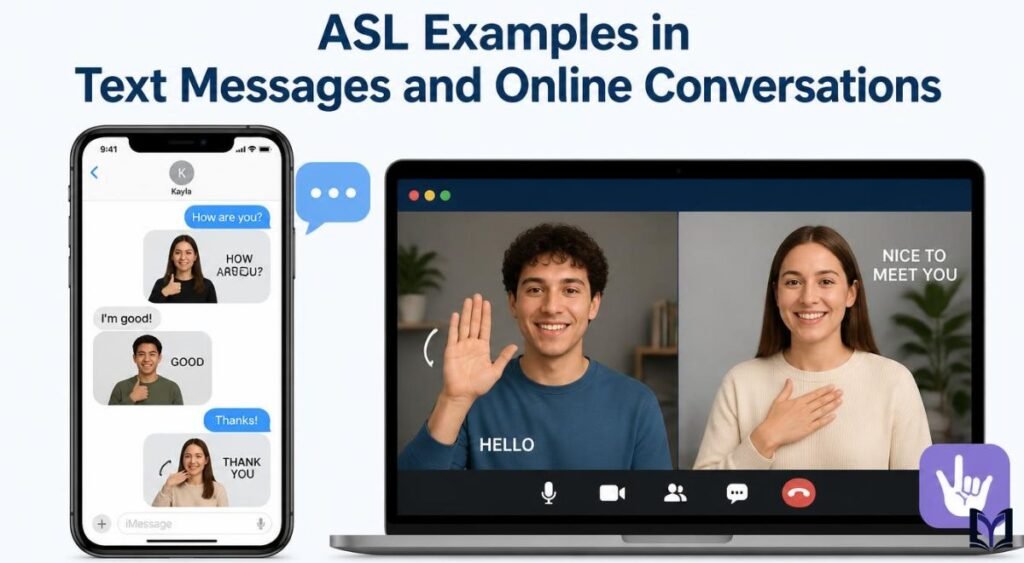
Real examples make the different meanings much easier to recognize. In older ASL in online conversations, “ASL?” usually works as a complete question. In modern ASL in text messages, the abbreviation may instead appear at the end of a description. Compare “ASL?” with “That movie was scary asl.” The first asks for personal information. The second means the movie was extremely scary. “She is learning ASL” introduces American Sign Language, while “The hospital hired an ASL interpreter” clearly refers to communication access. A sentence about an MRI could use ASL for arterial spin labeling, while an aviation sentence could use it for elevation.
| Example | Likely meaning | Why |
| “ASL?” | Age, Sex, Location | It appears as a complete question. |
| “I’m tired asl.” | As hell | ASL intensifies “tired.” |
| “Do you know ASL?” | American Sign Language | The wording suggests a language. |
| “We need an ASL interpreter.” | American Sign Language | “Interpreter” gives a strong clue. |
| “The study used ASL MRI.” | Arterial spin labeling | The subject is medical imaging. |
| “The town sits 4,000 feet ASL.” | Above sea level | The sentence discusses elevation. |
These examples show why context matters more than the letters themselves. Consider the sentence structure, the words nearby, and the subject of the conversation. Surrounding words such as “interpreter,” “MRI,” or “feet” can immediately point toward a specific meaning. Punctuation also helps. A standalone “ASL?” looks like a question, while “cute asl” places the abbreviation after an adjective. Capitalization can provide another clue, but it should never be treated as proof. Modern ASL internet abbreviation usage is flexible. People often type lowercase or uppercase letters without thinking about formal rules. The safest interpretation comes from the entire sentence rather than three letters alone.
Is ASL Still Used Today? Meaning Among Gen Z
The modern ASL meaning depends heavily on where and how the abbreviation appears. The traditional Age, Sex, Location meaning remains recognizable, but it isn’t as dominant as it was during early online chat culture. Many younger users encounter “asl” as ASL slang meaning “as hell,” especially on social platforms. For example, “I’m hungry asl” means the person is extremely hungry. At the same time, American Sign Language remains a widely recognized meaning in conversations about language, accessibility, education, and Deaf communities. This creates an interesting split. Older internet users may immediately think of “Age, Sex, Location,” while younger users may see “asl” and think of “as hell.”
Gen Z doesn’t use every abbreviation in exactly the same way. Online language changes quickly, and meanings vary between communities. A gaming group, a dating app, a school community, and a Deaf advocacy space can all use ASL differently. That’s why it would be misleading to claim that one meaning belongs to every younger user. The better approach is to examine the sentence and situation. ASL in internet slang has evolved alongside social platforms, smartphones, memes, and short-form communication. The abbreviation hasn’t disappeared. Instead, it has collected new meanings while older meanings remain alive in particular contexts.
ASL vs. Similar Texting Abbreviations
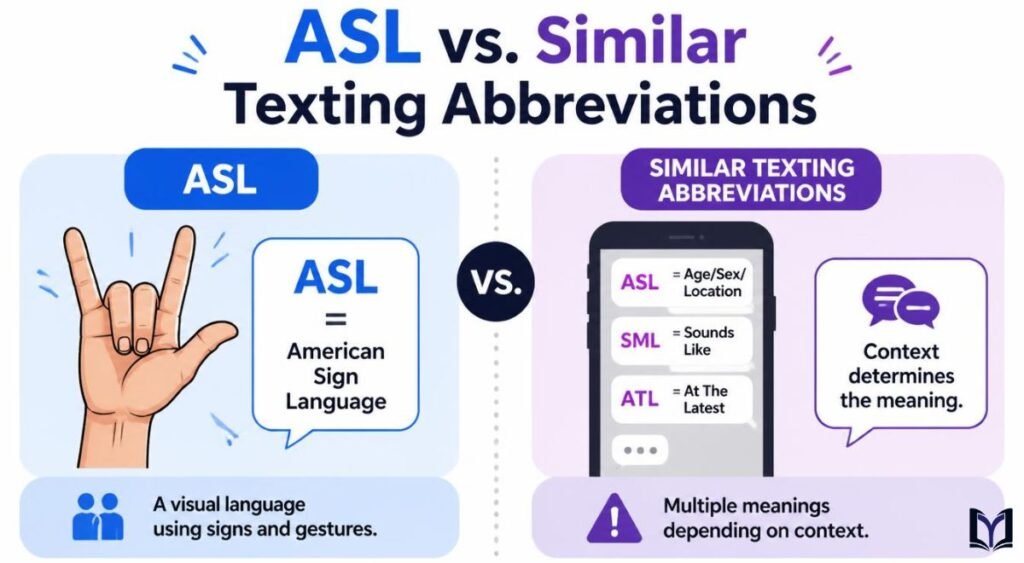
ASL becomes much easier to understand when you compare its meanings side by side. The traditional form means Age, Sex, Location, while the slang form means “as hell.” American Sign Language uses the same letters as a formal name for a language. Technical contexts introduce still more possibilities. For example, MSL commonly refers to mean sea level, while AMSL means above mean sea level. Medical research may use ASL for arterial spin labeling. These meanings aren’t interchangeable. The sentence surrounding the abbreviation acts like a signpost. It tells you which road to take.
| ASL or related term | Meaning | Common setting |
| ASL? | Age, Sex, Location | Old-style online chat |
| asl | As hell | Social media and casual texting |
| ASL | American Sign Language | Education and accessibility |
| ASL | Arterial spin labeling | Medical imaging |
| ASL | Above sea level | Aviation and geography |
| MSL | Mean sea level | Geography and aviation |
| AMSL | Above mean sea level | Aviation and elevation |
Grammar provides another useful clue. In “ASL?” the abbreviation stands alone as a question. In “beautiful asl,” it follows an adjective and acts as an intensifier. In “ASL interpreter,” it describes a language. In “ASL MRI,” it belongs to medical terminology. The difference may look tiny on the screen, but the sentence structure changes everything. That is why learning ASL meaning slang isn’t simply about memorizing one definition. You need to recognize how the abbreviation functions within the conversation.
Related Articles: MD Meaning in Text: What Does MD Mean in Chat & Social Media?
Other Meanings of ASL in Medical, Physics, Aviation & Everyday Contexts
Outside texting, ASL appears in several professional areas. American Sign Language is perhaps the best-known non-slang meaning. Schools may offer an ASL class, while hospitals, public services, and events may arrange an American Sign Language interpreter. In these settings, ASL connects to education, accessibility, communication, and Deaf culture. Medical researchers can also use ASL to mean arterial spin labeling, a technique used in medical imaging to examine blood flow without relying on the same approach as conventional contrast-based methods. Researchers may discuss ASL MRI when studying brain perfusion and neuroscience. In this setting, treating ASL as internet slang would completely change the meaning.
Science can introduce another layer of ambiguity. In physics, ASL may appear as a scientific abbreviation with a field-specific definition. The exact meaning depends on the paper, textbook, notation, or research area. Aviation provides another familiar example. ASL can mean above sea level when describing altitude or elevation. A statement such as “The airport is 2,000 feet ASL” refers to height above sea level. You may also encounter MSL, meaning mean sea level, or AMSL, meaning above mean sea level. These terms belong to specialized technical terminology, so the surrounding subject matters far more than internet slang.
| Field | ASL meaning | Example |
| Online chat | Age, Sex, Location | “ASL?” |
| Social media slang | As hell | “Funny asl” |
| Language | American Sign Language | “She studies ASL.” |
| Medical imaging | Arterial spin labeling | “ASL MRI measured brain perfusion.” |
| Aviation | Above sea level | “The airport sits 2,000 feet ASL.” |
| Physics and science | Field-specific abbreviation | Meaning depends on the research context. |
Conclusion
So, what does ASL mean in text? The answer depends on the conversation. In traditional online chat, ASL means Age, Sex, Location. In modern internet slang, lowercase “asl” often means “as hell” and adds emphasis to a description. ASL can also mean American Sign Language, especially in discussions involving sign language, education, accessibility, or communication. Medical, scientific, and aviation contexts introduce additional meanings. That variety explains why the same three letters can cause confusion.
When you see ASL, don’t jump to the first definition you remember. Check the surrounding words, sentence structure, and subject of the conversation. “ASL?” may ask for basic personal information, while “cute asl” uses slang. “ASL interpreter” refers to a language, while “ASL MRI” points toward medical imaging. Understanding the ASL meaning in text is ultimately a matter of reading the situation. When the meaning remains unclear, asking for clarification is often the simplest answer.
FAQs About What Does ASL Mean in Text
What does ASL mean in text?
ASL traditionally means “Age, Sex, Location,” but in modern slang, “asl” often means “as hell.” Context determines the meaning.
What does “I’m bored asl” mean?
“I’m bored asl” means “I’m extremely bored” or “I’m bored as hell.”
What does “I’m tired asl” mean?
“I’m tired asl” means “I’m extremely tired” or “I’m tired as hell.”
What does “pretty asl” mean?
“Pretty asl” means “very pretty” or “pretty as hell.” It’s an informal compliment.
What does hot ASL mean in text?
“Hot asl” usually means “extremely hot” or “hot as hell.” It can describe a person, outfit, weather, or situation depending on context.
Related Articles: MD Meaning in Text: What Does MD Mean in Chat & Social Media?

Welcome to Meanings There! I’m the creator and author behind this website, sharing useful meanings, explanations, and informative content to make words and phrases easier to understand.
1 thought on “What Does ASL Mean in Text? Meaning, Slang, Uses & Examples ”