

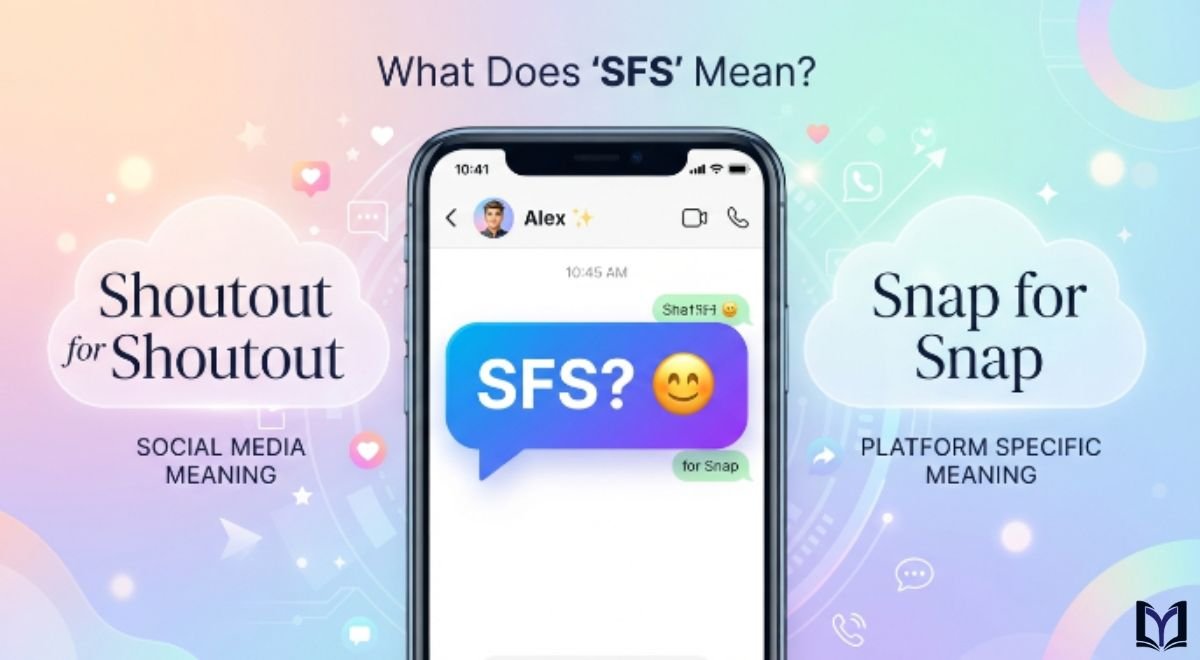
If you’ve ever seen #SFS on Snapchat, Instagram, or TikTok and wondered what does SFS mean in text, you’re not alone. This popular social media abbreviation has become a common part of online conversations, but its meaning can change depending on the platform and context. In most cases, SFS stands for Shoutout for Shoutout, while on Snapchat it may also mean Snap for Snap.
Understanding sfs meaning in text helps you communicate with confidence, grow your social presence, and avoid confusion. In this guide, you’ll learn the sfs full form, explore sfs meaning on Snapchat, discover real examples, and find out how to use SFS correctly in everyday texting and social media.
Quick Answer: What Does SFS Mean in Text?
The short answer is simple. What does sfs mean in text? In most online conversations, SFS stands for Shoutout for Shoutout. It is a popular social media abbreviation that people use to promote each other’s accounts. One person shares another person’s profile, story, or post. In return, the other person does the same. This process helps both users reach more people and can increase followers, improve profile visibility, and boost online engagement.
The meaning can change depending on where you see it. On Snapchat, SFS often means Snap for Snap, where two people agree to exchange snaps instead of promotions. In some smaller online communities, it may also mean Spam for Spam, although this version is much less common today. Because context matters, always look at the conversation before deciding which meaning fits best.
| Term | Details |
| Meaning | Shoutout for Shoutout |
| Another Meaning | Snap for Snap |
| Rare Meaning | Spam for Spam |
| Category | Internet slang, texting abbreviation |
| Tone | Friendly and casual |
| Common Platforms | Snapchat, Instagram, TikTok, WhatsApp, Facebook, Discord, X (Twitter) |
| Main Purpose | Exchange shoutouts, social media promotion, and account promotion |
What Does SFS Mean in Text?
If you’re wondering what does sfs mean in text, the answer usually depends on where the message appears. Across most social media platforms, sfs meaning refers to Shoutout for Shoutout. A shoutout happens when someone recommends another person’s account to their followers. When two users agree to exchange shoutouts, both accounts receive extra exposure. This type of mutual promotion has become common among content creators, influencers, musicians, photographers, artists, gamers, and even small businesses trying to grow online.
You will often see sfs meaning in social media inside captions, stories, comments, or a DM. Someone may write “SFS?” or add the sfs hashtag to a post. They’re simply asking another user if they would like to help each other grow. Instead of paying for advertising, many people choose this free method of social media marketing because it supports audience growth, improves engagement rate, creates creator networking opportunities, and strengthens the online community.
Shoutout for Shoutout (Most Common Meaning)
The most popular sfs full form is Shoutout for Shoutout. Imagine two YouTubers recommending each other’s channels. The same idea applies here. One Instagram creator shares another creator’s profile through Instagram Stories or a post. The second creator returns the favor. This simple form of cross-promotion helps both accounts attract new viewers. Many TikTok creators, photographers, fitness coaches, artists, and brands use this strategy because it supports social media growth without spending money on ads.
Snap for Snap (Snapchat Meaning)
When discussing sfs meaning on Snapchat, the meaning often changes to Snap for Snap. Instead of exchanging promotions, users simply agree to send snaps back and forth. This keeps conversations active and helps Snapchat friends stay connected. Some users also use sfs on Snapchat to exchange profile mentions, so reading the surrounding message is always important. Again, context matters, especially with modern Snapchat slang.
Spam for Spam and Other Less Common Meanings
Although rare, some online groups still use Spam for Spam. Here, two users agree to like or comment repeatedly on each other’s posts to improve user engagement. However, many social media platforms discourage this practice because it may appear unnatural. Outside social media, SFS can occasionally have completely different meanings, but when discussing internet communication, online slang, or common social media abbreviations, Shoutout for Shoutout remains the correct interpretation almost every time.
Related Articles: BB Meaning in Text: What It Means, How to Use It, and Real Examples (2026)
What Does SFS Stand For? Common Meanings Explained
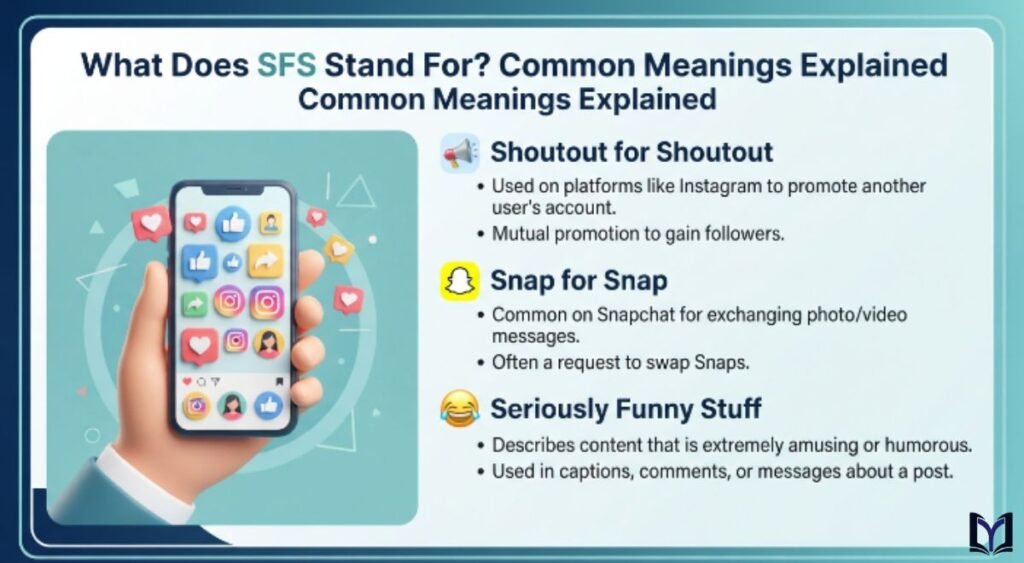
Many people ask what does sfs stand for because the abbreviation appears across different platforms. While the letters never change, the meaning often depends on the app, the conversation, and the user’s goal. Today, Shoutout for Shoutout is the definition most people recognize. It encourages social media sharing, account shoutout, and creator support between users who want to grow together. You’ll frequently see #SFS on Instagram, TikTok, and Snapchat because it quickly tells others that someone wants to exchange promotions.
Different platforms have shaped how people understand this abbreviation. On Instagram, creators often use sfs on Instagram to grow Instagram account visibility through Instagram Reels, stories, and posts. On Snapchat, users may think of Snap for Snap instead. On TikTok, the abbreviation usually points back to Shoutout for Shoutout, where creators work together to build organic reach, improve follower growth, and increase social media followers. Understanding these meanings helps you communicate naturally without confusion.
| SFS Meaning | Where It’s Common | Main Purpose |
| Shoutout for Shoutout | Instagram, TikTok, Facebook | Exchange promotions, profile promotion, audience growth |
| Snap for Snap | Snapchat | Exchange snaps and stay connected |
| Spam for Spam | Small online communities | Boost activity through repeated interactions |
Shoutout for Shoutout (Most Common Meaning)
The phrase Shoutout for Shoutout explains itself well. Two users agree to recommend each other’s profiles publicly. For example, an artist may post “Doing #SFS today!” Another artist agrees, and both introduce their followers to someone new. This approach works best when both accounts share similar interests because followers are more likely to enjoy related content.
Snap for Snap (Snapchat Meaning)
The second meaning, Snap for Snap, belongs mostly to Snapchat slang. Friends often exchange snaps to keep conversations active or maintain daily streaks. If someone messages “SFS?” on Snapchat, they may simply want to swap snaps rather than promote profiles. Reading previous messages helps you understand their intention.
Spam for Spam and Other Less Common Meanings
Although Spam for Spam still exists in some online circles, it has become much less common than it was years ago. Many platforms now prefer genuine interaction over artificial engagement. As a result, most users today understand SFS as Shoutout for Shoutout, especially when discussing Instagram slang, TikTok slang, or modern social media trends.
What Does SFS Mean on Different Platforms?
The meaning of SFS stays similar across most social media apps, but each platform has its own style. Understanding sfs meaning on Snapchat, sfs meaning on Instagram, sfs meaning on TikTok, and sfs meaning on WhatsApp helps you avoid confusion. While the goal is usually to connect with more people, the way users apply SFS depends on the features of each platform. Some people use it for account promotion, while others simply use it to stay connected with friends.
If you receive an SFS request, don’t assume it always means the same thing. Read the conversation first. Look at where the message appears and who sent it. A creator with thousands of followers may want exchange promotions, while a close friend may only want to exchange snaps. Once you understand the platform, the meaning becomes much easier to recognize.
SFS Meaning on Snapchat
The sfs meaning on Snapchat usually refers to Snap for Snap, although many users also use it as Shoutout for Shoutout. If someone sends “SFS?” through a DM or posts it in Snapchat Stories, they’re often asking if you’d like to exchange snaps or promote each other’s profiles. This makes sfs on Snapchat one of the most flexible examples of common texting slang. Younger users especially use it to keep conversations active and maintain friendships.
SFS Meaning on Instagram
The sfs meaning on Instagram almost always refers to Shoutout for Shoutout. This is where the abbreviation became especially popular among content creators, influencers, photographers, fitness coaches, artists, and small businesses. Users post another person’s profile in Instagram Stories, mention them in captions, or feature them inside Instagram Reels. This type of social media support helps both creators enjoy better profile visibility, stronger online engagement, and long-term audience growth.
SFS Meaning on TikTok
The sfs meaning on TikTok also stands for Shoutout for Shoutout. Although TikTok’s algorithm already helps videos reach new viewers, many TikTok creators still use sfs on TikTok to introduce followers to other creators. This creates creator collaboration, improves organic reach, and increases social media followers without paid advertising. You may notice users writing #SFS in comments or video captions when they want to connect with similar accounts.
SFS Meaning on WhatsApp, Facebook, Discord, and X (Twitter)
The sfs meaning on WhatsApp appears less often than on Instagram or Snapchat, but people still use it in WhatsApp chats when discussing social media. Someone may ask if you’d like to promote each other’s Instagram page or TikTok account. The same idea appears inside Facebook groups, Discord servers, and X (Twitter) communities where creators support one another through social networking and creator networking. Although the wording stays the same, the purpose remains simple: help each other reach a larger audience.
| Platform | Most Common Meaning | Typical Purpose |
| Snapchat | Snap for Snap or Shoutout for Shoutout | Exchange snaps or profile promotions |
| Shoutout for Shoutout | Social media growth and profile promotion | |
| TikTok | Shoutout for Shoutout | Reach more viewers and improve user engagement |
| Shoutout for Shoutout | Discuss promotions in private chats | |
| Shoutout for Shoutout | Support pages and businesses | |
| Discord | Shoutout for Shoutout | Build creator communities |
| X (Twitter) | Shoutout for Shoutout | Share profiles with followers |
Why Do People Use SFS in Text and Social Media?
People use SFS because it offers a simple way to grow together. Instead of competing for attention, users support one another through mutual promotion. Whether someone creates travel videos, sells handmade products, shares artwork, or posts gaming clips, SFS allows them to introduce their audience to another account. This creates trust because recommendations from real people often perform better than paid advertisements.
Many creators also prefer SFS because it costs nothing. A small business can reach hundreds of potential customers through one recommendation. A new creator can gain followers by connecting with someone who already has an active audience. That’s why social media marketing often includes exchange shoutouts, cross-promotion, and creator collaboration as effective growth strategies. When used honestly, SFS strengthens the creator community and encourages long-term relationships instead of one-time promotions.
| Reason | Benefit |
| Exchange shoutouts | Better profile visibility |
| Promote social media account | More social media followers |
| Support friends | Stronger online community |
| Creator collaboration | Shared audiences |
| Account promotion | Better engagement rate |
| Social media sharing | Improved organic reach |
| Build relationships | Long-term creator partnerships |
A good example comes from two photography creators. One specializes in nature while the other focuses on street photography. They agree to exchange shoutouts through Instagram Stories. Their followers discover fresh content that matches their interests. Both creators gain new followers because the recommendation feels genuine rather than forced. This simple partnership shows why SFS continues to remain popular across modern social platforms.
How to Use SFS in Conversations (With Real Examples)
Learning how to use sfs is easy once you understand its purpose. Keep your request short, polite, and relevant. Most users simply ask another creator if they’d like to exchange promotions. Others include the sfs hashtag in a story or caption so interested users can respond. Respect always comes first. If someone declines, thank them and move on. Good social media etiquette helps you build genuine connections instead of appearing spammy.
Timing also matters. Ask creators whose audience matches your content instead of messaging random strangers. For example, if you run a fitness page, another fitness creator is a much better match than a cooking account. Relevant partnerships usually create higher engagement rate, better social media growth, and stronger viral content opportunities because followers already enjoy similar topics.
The following table shows natural sfs examples and real conversation examples that you can use in everyday online conversations.
| Situation | Example Conversation |
| Instagram DM | Alex: “Want to do SFS?” Emma: “Sure. Send your username.” |
| Snapchat | Ryan: “SFS?” Jake: “Absolutely. I’ll send a snap now.” |
| TikTok | Mia: “Anyone doing #SFS today?” Chris: “I’m interested.” |
| Sarah: “Would you like to promote each other’s pages?” Ben: “Sounds good.” | |
| Olivia: “Let’s exchange shoutouts for our small businesses.” Noah: “Great idea.” |
These sfs conversation examples show that SFS isn’t complicated. Most conversations stay short because both users already understand the abbreviation. However, clear communication still helps. If you’re asking someone to share my post, explain what you expect. Tell them whether you want a story share, a profile mention, or a simple repost. Clear expectations create smoother exchange promotions and stronger creator support.
One useful habit is to personalize every request. Instead of sending the same message to dozens of people, mention why you like their content. Genuine compliments make your request feel authentic rather than automated. Over time, this approach builds trust, improves internet communication, and helps you create lasting relationships within your niche.
How to Reply to SFS Messages

Receiving an SFS request is common if you’re active on social media. Knowing how to reply to sfs helps you respond politely and professionally. Before answering, look at the person’s profile and decide whether their content matches yours. If you think the partnership will benefit both accounts, accept the request with a friendly reply. If it isn’t the right fit, you can politely decline without hurting the conversation. Good communication builds trust and reflects strong social media etiquette.
Your response should always be clear. Avoid confusing or one-word answers if more information is needed. If you agree, ask for the username or the post they want you to share. If you aren’t interested, thank them for asking and move on. A respectful reply leaves a good impression and helps maintain healthy relationships within the creator community.
| SFS Message | Best Reply |
| “SFS?” | “Sure! Send me your username.” |
| “Want to exchange shoutouts?” | “I’d love to. Send me your profile.” |
| “Can we do SFS today?” | “Yes, let’s do it this evening.” |
| “SFS for my new page?” | “Sounds good. I’ll share it once you send the link.” |
| “SFS?” | “Thanks for asking, but I’ll pass this time.” |
| “Can you promote my account?” | “Sorry, I don’t do promotions right now.” |
A real example makes this even easier to understand. Imagine a travel creator receives a message saying, “SFS today?” Instead of replying with only “Okay,” they answer, “Sure! Send me the post you’d like me to share.” This creates a smoother conversation and avoids misunderstandings. These simple reply to SFS examples show how easy professional communication can be.
Another good habit is checking the quality of the content before agreeing. Sharing useful posts protects your reputation and keeps your audience interested. If you recommend low-quality or unrelated content, your followers may lose trust. That’s why many experienced content creators carefully choose who they support through social media sharing and account shoutout opportunities.
SFS vs Similar Texting Slang
Many people confuse SFS with other internet abbreviations because they often appear on the same platforms. However, each abbreviation serves a different purpose. While SFS focuses on exchange promotions, others describe actions, opinions, or online behavior. Understanding these differences helps you communicate naturally and prevents awkward misunderstandings in casual texting.
The easiest way to remember SFS is by thinking about cooperation. It encourages two people to help each other grow. Other abbreviations such as DM, TBH, or AFK have completely different meanings even though they often appear in the same conversations. Learning these common terms improves your understanding of modern internet acronyms and online slang.
SFS vs F4F
F4F stands for “Follow for Follow.” Unlike SFS, which focuses on sharing another person’s account, F4F asks users to follow each other directly. Both methods support follower growth, but SFS usually reaches a wider audience because followers discover new accounts through recommendations rather than simple follow exchanges.
SFS vs LFL
LFL means “Like for Like.” Here, users exchange likes instead of profile mentions. While both abbreviations encourage interaction, SFS creates stronger profile promotion because it introduces your account to completely new people rather than simply increasing likes on one post.
SFS vs TBH
Many beginners compare SFS vs TBH, but the meanings are unrelated. TBH stands for “To Be Honest” and introduces an honest opinion. SFS focuses on social media promotion and creator collaboration instead of expressing personal thoughts.
Related Articles: BB Meaning in Text: What It Means, How to Use It, and Real Examples (2026)
SFS vs DM
The comparison between SFS vs DM also causes confusion. A DM simply means a private message. SFS is the request itself. In many cases, someone publicly posts #SFS and then continues the conversation through a direct message.
| Abbreviation | Full Form | Main Purpose | Common Platform |
| SFS | Shoutout for Shoutout | Exchange promotions | Instagram, TikTok, Snapchat |
| F4F | Follow for Follow | Exchange follows | |
| LFL | Like for Like | Exchange likes | |
| TBH | To Be Honest | Share opinions | Texting & Social Media |
| DM | Direct Message | Private conversation | All platforms |
| AFK | Away From Keyboard | Show temporary absence | Gaming & Chat Apps |
You may also come across comparisons like SFS vs AFK or SFS vs FYP. These abbreviations belong to different situations. AFK tells people you’re temporarily unavailable, while FYP refers to TikTok’s “For You Page.” Neither abbreviation has anything to do with promotional posts, making them very different from SFS.
When Should You Use or Avoid SFS?
Knowing when to use SFS is just as important as knowing what it means. SFS works best when both users benefit from the partnership. If you create similar content, your followers are more likely to enjoy each other’s profiles. This makes creator collaboration feel natural instead of forced. Whether you’re promoting artwork, photography, fitness, education, or a local business, relevant partnerships often produce better results than random promotions.
You should also think about your audience before accepting every request. Followers appreciate useful recommendations, but they may become annoyed if every post turns into an advertisement. A balance between regular content and social media support keeps your page interesting and trustworthy. Authentic recommendations usually create stronger online engagement than constant promotional activity.
| Good Time to Use SFS | Time to Avoid SFS |
| Launching a new account | Messaging strangers repeatedly |
| Supporting another creator | Ignoring platform rules |
| Promoting a small business | Sending spam requests |
| Community events | Professional business emails |
| Creator partnerships | Unrelated comment sections |
| Shared audiences | Low-quality content |
Consider this example. Two food bloggers agree to exchange shoutouts because both create healthy recipes. Their followers enjoy similar content, so both accounts gain genuine interest. Now imagine a gaming page asking a medical clinic for SFS. The audiences don’t match, so the promotion provides little value. Choosing relevant partnerships makes every recommendation more effective.
Finally, remember that when not to use SFS is often a matter of respect. Don’t send repeated requests after someone declines. Don’t fill comment sections with promotional messages. Don’t pressure creators into sharing your content. Strong relationships grow through honesty, patience, and mutual respect. Following these simple habits helps you build a positive reputation while supporting healthy social media trends and long-term creator networking.
Conclusion
By now, you should have a clear answer to what does sfs mean in text. In most situations, SFS stands for Shoutout for Shoutout, which allows two users to promote each other’s profiles and grow together. On Snapchat, it may also mean Snap for Snap, while Spam for Spam appears only in a few online communities. The platform and the conversation usually reveal the correct meaning, so always remember that context matters.
Today, SFS remains one of the most popular forms of internet slang used by content creators, influencers, brands, and everyday users. Whether your goal is social media growth, better profile visibility, stronger user engagement, or meaningful creator collaboration, using SFS respectfully can help you connect with the right audience. If you understand the different meanings and apply them wisely, you’ll communicate more naturally across today’s social platforms.
FAQ’s About What Does Sfs Mean In Text
What does what does SFS mean in text?
In text, SFS usually means “Shoutout for Shoutout,” where two users agree to promote each other’s social media accounts. On Snapchat, it can also mean “Snap for Snap.”
What does SFS slang mean?
SFS is an internet slang abbreviation commonly used on social media to request or offer mutual promotion between users.
Why do people do SFS?
People use SFS to gain more followers, increase engagement, promote their content, and support other creators through mutual shoutouts.
Is SFS an internet slang term?
Yes, SFS is a popular internet slang term and social media abbreviation used on platforms like Instagram, Snapchat, and TikTok.
How does SFS work on Instagram?
On Instagram, SFS works by two users sharing each other’s profiles or posts through Stories, Reels, or posts to help both accounts reach a wider audience.
Related Articles: BB Meaning in Text: What It Means, How to Use It, and Real Examples (2026)

Welcome to Meanings There! I’m the creator and author behind this website, sharing useful meanings, explanations, and informative content to make words and phrases easier to understand.